





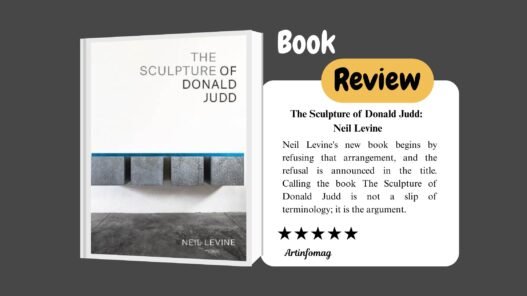
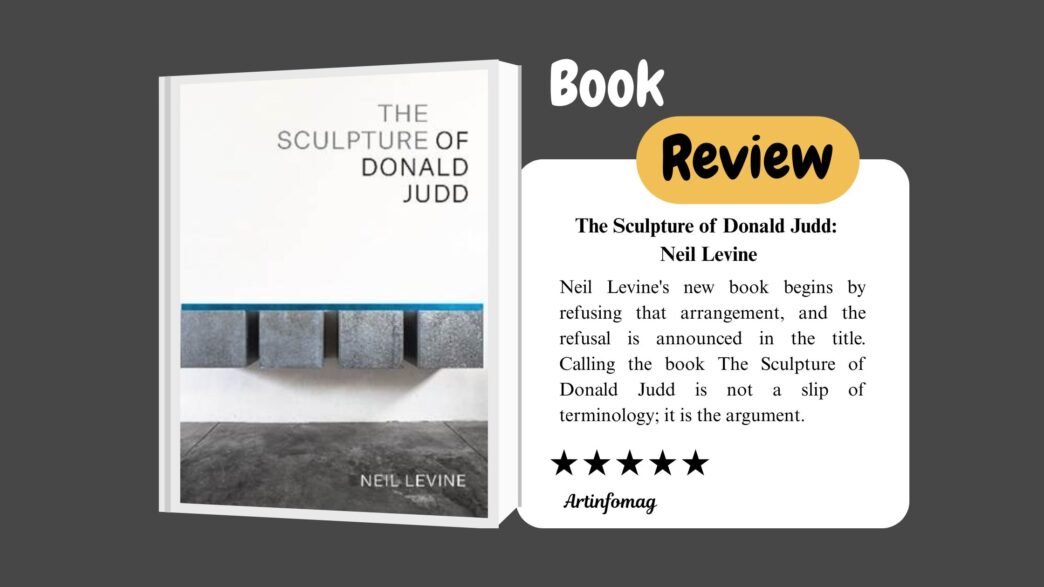
Neil Levine, The Sculpture of Donald Judd. Yale University Press, 192 pp., more than 150 illustrations.
The Sculpture of Donald Judd publishes on October 13. It can be preordered via Amazon or directly from Yale University Press.
Few artists have policed their own reception as effectively as Donald Judd. He rejected “Minimalism.” He rejected “sculpture.” He preferred “three-dimensional work,” and even after he had abandoned the canvas he liked to insist that he was, at heart, a painter. Traditional sculpture — carving, modelling, the whole inherited apparatus — he dismissed as old-fashioned. Critics obliged him. For sixty years, the standard way of writing about Judd has been to quote Judd.
Neil Levine’s new book begins by refusing that arrangement, and the refusal is announced in the title. Calling the book The Sculpture of Donald Judd is not a slip of terminology; it is the argument. Levine, an architectural historian by training and Emmet Blakeney Gleason Professor Emeritus at Harvard, contends that whatever Judd wished to call it, the work has a space-occupying, space-defining physical presence, and belongs to the modern “third way” of constructed sculpture opened up by Picasso and David Smith — neither carved nor modelled, but built.
The vicious circle
The opening chapter, “Premises,” is where Levine lays out both the problem and the method. The problem he names is a vicious circle: scholars have used Judd’s elliptical writings and his philosophy training to explain his objects, then found in the objects a confirmation of the writings. The result is a Judd who never changes — a monolith produced by a closed loop of interpretation.
Levine’s way out is almost old-fashioned in the best sense. He insists on a strict chronological framework, on the assumption that formal change is real and legible, and that philosophical continuity should not be allowed to flatten thirty years of decisions into a single position. He borrows a principle from Richard Serra: the work is encountered first through perception, an experience that is physical and kinesthetic before it is theoretical. And he reads closely, concentrating on what he calls the prime objects — the first pieces that opened a series — rather than dutifully describing every subsequent variant.
There is a polemical target behind this. Judd’s move into three dimensions was, in Levine’s account, a reaction against Clement Greenberg’s modernism, with its insistence on the ineluctable flatness of painting and its verdict that sculpture was the less advanced medium. Judd’s answer, Levine suggests, was to use a painter’s training to push sculpture into uncharted territory: a volume bounded by thin planes, which might be read as the most modernist sculpture of all.
Four stages, one argument
The book divides Judd’s career into four periods, and the division is not administrative — it carries the thesis:
- 1961–63 — the irreversible move out of painting, by way of the found object.
- 1964–68 — the hollow galvanized boxes, and the turn to industrial fabrication.
- 1968–79 — non-perspectival space, site-dependency, site-specificity.
- 1980–94 — pictorialism and polychromy, with colour becoming structural.
The early chapters are the most quietly surprising. Judd took the found object from Duchamp but stripped it of everything Duchamp and Jasper Johns valued in it: no iconography, no wit, no symbolism, only aesthetic quality and the capacity to define space. A baking tin, a plastic letter “O,” a copper disc — these were embedded in painted supports to open actual holes in them. In The Black Painting (1961), a metal baking tin sits in a vertical, colourless field that invites comparison with Frank Stella and then declines it: the subject is the object, not the painting that frames it. In the Cadmium Red Light paintings of 1962, sand-textured monochromes that acknowledge Yves Klein, one work carries a yellow plastic “O” flipped inside out so that its hollowness becomes the point. Depth arrives before sculpture does.
The fabricator as collaborator
Levine’s treatment of fabrication is among the book’s most useful passages, and it is where an architectural historian’s eye pays off. In 1964 Judd began working with Bernstein Brothers, a New York sheet-metal firm. Their first job — a wall relief for Frank Stella — still used galvanized iron fitted over a handmade wooden core; it was the last time Judd would do so. What followed were hollow seamed units built on the logic of heating and ventilation ductwork.
Bending metal turns out to explain a great deal. It stiffened the boxes; it held plexiglass without internal framing; and it produced the discreet trick of the downturned lip at the back of a wall box, hooked over stepped steel plates screwed into the wall so that the support disappeared from view. Two decades later, in the multicoloured enamelled aluminium works from 1984 onward, Judd inverted the logic and bolted plates together with their folded edges facing out, so that the method of construction became part of what you look at.
Fabrication also made interchangeability possible — the practice of running one format as both wall relief and floor piece. Levine points to the 1966 Primary Structures exhibition, where Judd showed two pieces identical in format, a series of boxes with a square aluminium tube, one hung on the wall and the other set on the floor directly in front of it. Position becomes a variable rather than a genre. The anthropomorphic expectations of standing sculpture and the illusionism of the hung picture are both quietly cancelled.
Where the book leaves you
What emerges is a Judd who is far less doctrinaire than his prose. Levine tracks influences Judd rarely advertised: Brancusi’s Endless Column behind the “stack”; Barnett Newman’s zip behind the projecting pipe; Lee Bontecou’s threatening concrete voids behind Judd’s craters; and late in life, Matisse, whose all-over decorative field shapes the large polychrome wall reliefs. There is even a Wölfflinian curve to the whole story — linear and classic at the start, open and pictorial by the end — and, in Marfa, an ambition of total design that owes as much to Frank Lloyd Wright and to Mies’s beinahe nichts as to anything in the artist’s essays.
Readers who take Judd’s writings as scripture will find things to argue with here, which is precisely the book’s value. At 192 pages, generously illustrated in colour, it is compact enough to be read in a sitting and specific enough to change how the next box looks. Levine’s wager is that Judd’s work survives being taken away from Judd’s commentary. On the evidence assembled here, it does — and gains something in the exchange.