




The question is usually asked in a tone of mild moral alarm, as though a yes would confirm that the art market has finally abandoned judgement for metrics. The honest answer is more interesting than either the alarm or the dismissal: followers influence value, but not in the way most people assume, and not in the same way in every part of the market. A number that is decisive in one segment is close to irrelevant in another.
Getting this right matters practically, because artists allocate real time on the basis of their assumptions about it. An artist who believes the follower count is the lever will spend evenings producing content. An artist who believes it is noise will ignore a genuinely useful instrument. Both are making a bet on an empirical question that has some actual evidence behind it.
What the evidence shows
The most relevant study is modest in scope and unusually clear in design. Analysing more than three thousand online auction sales by eighty-seven American watercolourists across eBay, LiveAuctioneers and EBTH, researchers measured reputation through museum placements, archival holdings and book references — and added Instagram mentions as a fourth indicator. Every reputation indicator they tested, including the number of Instagram hashtag references, correlated positively with an artist’s average sale price, after controlling for painting characteristics such as size and medium.
That is a real finding and it should be taken seriously. It should also be read carefully. The study measures hashtag mentions — how much other people are talking about an artist — rather than follower count, which is closer to a measure of broadcast reach. It covers a mid-market online auction segment rather than evening sales at Christie’s. And, decisively, it establishes correlation. Artists with museum placements also tend to be discussed online; a single underlying variable, call it reputation, plausibly drives both.
The market-survey evidence points the same way. Hiscox’s annual online art trade reports have for years identified Instagram as the dominant social channel for art, with a majority of surveyed buyers using it regularly — while simultaneously finding that online purchases cluster at the lower end, with the large majority of online buyers spending under $5,000. Those two findings belong together. Social media is where discovery happens; it is not where the expensive transactions happen.
Three markets, three answers
The confusion in this debate comes from treating “the art market” as one thing. It is at least three, and followers function differently in each.
Direct sales from the studio. Here the relationship is close to causal, and the mechanism is not mysterious: an audience is a distribution channel, and the artist captures the full margin. There are well-documented cases of artists building substantial businesses on this basis — CJ Hendry selling direct to collectors and funding her own pop-up exhibitions without gallery representation is among the clearest. A Forbes profile from 2017 described a twenty-six-year-old artist making forty per cent of his sales through Instagram, and noted that most of his buyers were in their forties and fifties despite the account’s much younger audience. That last detail is the useful one: the followers are not the buyers. They are the pool from which a much smaller number of buyers surfaces.
Primary market through galleries. Here the influence is real but indirect and often misread. Galleries do look at an artist’s following, but mostly as evidence of audience-building capacity and professional seriousness, not as a price input. A dealer’s actual question is whether they can place the work with collectors who matter, and a large Instagram audience of other artists and students does nothing for that. A modest audience containing six serious collectors does a great deal. Several dealers have been candid that a large following can even raise suspicion, if it suggests the artist is optimising for a market the gallery cannot monetise.
Secondary market and auction. Here the follower count is closest to irrelevant, and the reason is structural. Auction prices are set by the small number of people willing to bid at that level, and their decisions run on consignment quality, provenance, prior auction records, institutional validation and the judgement of advisers. There is no mechanism by which a hundred thousand followers raises a hammer price, because those followers are not in the room, online or otherwise.
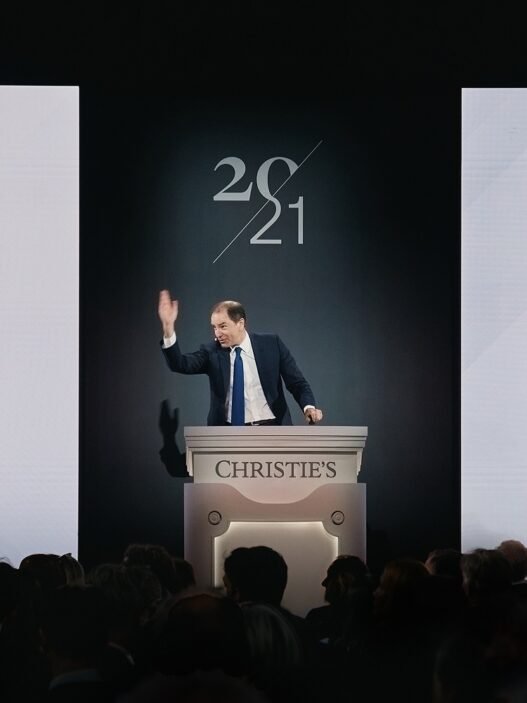
The apparent counter-example is Beeple, and it is worth examining rather than waving away. He posted a new digital image daily from 2007 without missing one, and in March 2021 the compiled result sold at Christie’s for $69.3 million. The audience was clearly load-bearing — but what it carried was the narrative: fourteen years of unbroken daily practice, publicly verifiable, which is a story about commitment rather than a number of followers. The price itself was produced by crypto-wealth liquidity meeting a legitimising auction house at a specific moment. The followers were necessary and nowhere near sufficient.
What actually transfers into value
Reading across the cases, the followers themselves are rarely the active ingredient. Four things that travel with a following do the work.
Discoverability. Curators, dealers, residency juries and writers genuinely do research artists online, and an account that shows coherent current work functions as a permanently open studio. This is real and it is the strongest argument for maintaining a presence at all.
Demand signalling. A gallery pricing an unknown artist is guessing. An artist who can demonstrate a waiting list, sold-out editions or consistent direct sales removes the guesswork, and pricing moves accordingly. Note that it is the sales evidence doing this, not the follower number — which is why an artist with 4,000 followers and a sold-out print run is in a stronger negotiating position than one with 90,000 and no sales history.
Narrative. Markets price stories. A public practice that makes a coherent artistic development legible over years is a durable asset; a feed of disconnected finished images is not.
Independence. The least discussed and possibly most valuable. An artist who can reach buyers directly can decline a bad contract. That changes terms — commission splits, exclusivity, exhibition commitments — in ways that affect lifetime earnings far more reliably than any price uplift.
The engagement point, and the arithmetic
Follower count is the weakest available metric and the one everyone quotes. An account with 5,000 followers and 8% engagement reaches more people who care than one with 100,000 at 0.5%, and because engagement rates decline as accounts grow, mid-sized artist accounts are frequently the commercially healthier ones.
Run the conversion arithmetic and the point sharpens. Suppose a modest but plausible 0.1% of an engaged audience ever buys something. Twenty thousand followers yields twenty buyers over the life of the account. At €400 a work that is €8,000 — meaningful, not transformative. The artists for whom social media genuinely changed the economics are almost always those selling multiples, editions, or merchandise at volume, or those whose audience happens to contain a few people with real purchasing power. Both are worth pursuing deliberately. Neither follows automatically from growth.
There is also a cost that the enthusiastic version of this argument never prices in. Content production competes directly with studio time, and the platform rewards frequency, legibility and image-friendliness — qualities that quietly select against slow work, large work, difficult work and work that photographs badly. The feedback loop is real, and some artists have found their practice drifting toward what performs before they noticed it happening. That is a genuine artistic cost, and it is paid in the same currency as the benefit.
So: yes, but
Social media followers influence art market value, chiefly by accelerating the processes that have always set it — visibility, reputation, demonstrated demand — rather than by replacing them. The influence is strongest in direct sales and in the lower-to-middle price bands, weaker in the gallery primary market, and close to nil at auction. A large following with no sales, no institutional validation and no critical attention produces very little price movement, which is why the artists with the biggest audiences are frequently not the ones with the highest prices.
The practical conclusion for an artist is unglamorous. Treat the account as a professional instrument: current, accurate, documented, easy to contact through. Measure it by how many serious conversations it produces, not by its follower count. And resist the inference that the number itself is the asset. It is a proxy, and the market has always been reasonably good at pricing proxies at a discount to the thing itself.
Sources
- Zickar, M. J. & Stevenor, B., “An Evaluation of Reputation Using Online Auction Data for a Group of American Watercolorists,” Empirical Studies of the Arts (2023) — https://journals.sagepub.com/doi/10.1177/02762374221143712
- Hiscox Online Art Trade Report, as reported by Forbes — https://www.forbes.com/sites/zarastone/2017/09/19/how-a-26-year-old-artist-makes-40-of-sales-through-instagram/
- “40 Most Influential Artists Dominating Instagram,” MoMAA — https://momaa.org/40-most-influential-artists-dominating-instagram/
- “Can Instagram bring the big auction houses into the digital age?”, The Art Newspaper — https://www.theartnewspaper.com/2021/05/14/can-instagram-bring-the-big-auction-houses-into-the-digital-age