




Triennial of Photography Hamburg 2026 Review: Mark Sealy’s “Alliance, Infinity, Love” Is the Most Generous Photo Festival of the Year
There is a version of the international photography festival that has become depressingly easy to predict: a theme broad enough to accommodate anything, a headline name or two, and a scatter of shows that share a poster and little else. The 9th Triennial of Photography Hamburg is not that. Running 5 June to 22 September 2026 across eleven exhibitions in eight institutions, it is the rare large-scale festival where the curatorial premise actually holds — and where the argument being made about photography is one worth arguing back with.
Four weeks remain before it closes. Here is what matters, and what to see if you only get one weekend.
The basics: dates, venues, and who is behind it
The festival runs from 5 June to 22 September 2026, with the opening ceremony held at Deichtorhallen Hamburg on 4 June and Opening Days stretching to 14 June. Eleven exhibitions are spread across eight partner institutions, among them the Deichtorhallen (Hall for Contemporary Art, PHOXXI – Temporary House of Photography, the F.C. Gundlach Collection and the Falckenberg Collection), the Hamburger Kunsthalle, the Museum für Kunst und Gewerbe, the Bucerius Kunst Forum, MARKK, Kunsthaus Hamburg, Kunstverein in Hamburg, and the Museum of Work.
The Triennial was founded in 1999 by collector and fashion photographer F.C. Gundlach and has since become Germany’s most consequential photography event. Its structural quirk is also its strength: each edition is handed to a different artistic director, so the festival reinvents its politics every three years. Krzysztof Candrowicz took 2018; the late Koyo Kouoh led the 2022 edition around the theme of Currency.
This time it is Prof. Dr. Mark Sealy OBE — the London-based curator, writer and long-time director of Autograph ABP, whose career has been built on dismantling the colonial habits of the Western photographic gaze and pulling overlooked practitioners into the centre of the frame. Anyone who has read Decolonising the Camera will recognise the intellectual architecture underneath this festival immediately.
The theme, and why it is more than a slogan
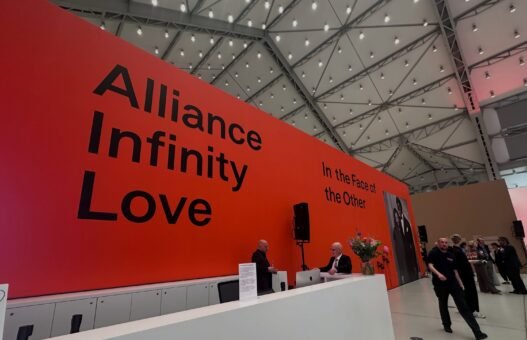
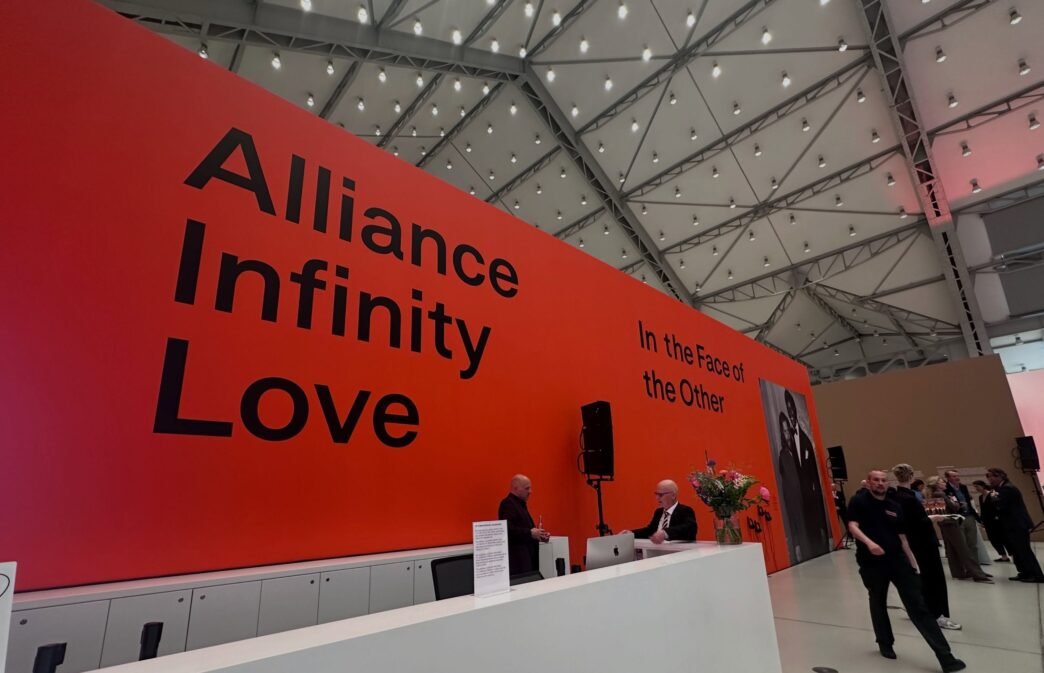
The title is “Alliance, Infinity, Love — in the Face of the Other.” Three words, three thematic fields, and — usefully for a visitor trying to plan — a genuine organising logic rather than decorative branding.
- Alliance covers solidarity and collective action: photography as an instrument of campaigning, kinship and shared struggle.
- Infinity treats the photograph as something that does not simply record a moment but keeps working on it — archives reopened, colonial images turned against themselves, past and future held in one frame.
- Love puts the human, the tender and the intimate at the centre, including the material intimacy of the photographic object itself.
The phrase “in the face of the Other” is doing real philosophical work here — it is Levinasian in spirit, and it commits the festival to a position: that every act of looking carries an ethical obligation to the person looked at. Sealy’s stated ambition is a new understanding of visibility, and the festival’s argument is that photography can do more than observe — it can connect, and it can prompt reflection on justice and responsibility. Whether images can bear that weight is the productive question the whole Triennial leaves open.
The best part: the central exhibition at Deichtorhallen
If you see one thing, see the title exhibition — “Alliance, Infinity, Love — in the Face of the Other” at the Deichtorhallen’s Hall for Contemporary Art, curated by Sealy himself.
It gathers over 30 artistic positions across photography, video and film, and it is the clearest statement of what this edition believes. The list is remarkable in its range: Hélène Amouzou, Sandra Brewster, Didier Ben Loulou, Mario Cravo Neto, Rotimi Fani-Kayode, Lee Jaffe, Teresa Margolles, Mónica de Miranda, Tyler Mitchell, the Lee Shulman and Omar Victor Diop collaboration, Inuuteq Storch, Matthew Thorne with Derik Lynch, and Nil Yalter, among others.
What makes it the high point is not the scale but the tonal decision. A show built on decolonial critique could easily have been an inventory of harm. Instead it leans into joy, community, tenderness, dignity and intimacy — Fani-Kayode’s ecstatic bodies in the same conversation as Storch’s Greenlandic vernacular archive and Mitchell’s soft-focus Black pastoral. The healing and transformative capacity of the medium is treated as a serious curatorial thesis rather than a consolation prize. That is a harder show to make than the angry one, and it is the reason this Triennial will be remembered.
The rest of the programme, ranked by what it offers
“BUT I WORLD I SEE YOU*” (*Rémy Zaugg) — Hamburger Kunsthalle. The most ambitious secondary show and the intellectual anchor of the festival, bringing together more than 40 international artists across three chapters that run from photography’s earliest experiments to the present. It meditates on landscapes of memory, the transformation of form, and the poetic and political charge of the archive. Give it a full afternoon; it does not reward rushing.
“Franki Raffles. Photography, Activism, Campaign Works” — Museum of Work. The purest expression of Alliance. Raffles documented the working lives of women in the 1970s and 80s and used the camera explicitly as a campaigning tool against injustice. A rediscovery for most visitors, and one of the shows where the festival’s ethics and its images are perfectly aligned.
“Care. Reconsidering Photography” — Museum für Kunst und Gewerbe. Sara Sallam works through the museum’s own archaeological and photographic holdings to trace how colonial images keep exerting force, building counter-narratives that ask for a more compassionate relationship with the past. Institutional self-critique performed from inside the institution — the model other museums should be copying.
“Resonating Images from Peru” — MARKK. Historical photographs and audio recordings made by the German amateur researcher Hans Heinrich Brüning (1848–1928) are handed back to contemporary Peruvian artists and scholars, who reinterpret them into a living archive. The most methodologically interesting project of the eleven.
“Whispers” — Melike Kara at Kunsthaus Hamburg. A large-scale installation drawing on the artist’s Kurdish heritage, working through identity, memory and healing via material she has spent years researching and archiving.
“Inner Mornings, or Forms of Counterculture” — Falckenberg Collection. Departing from Claude Cahun, it frames artistic resistance as an unfinished, ongoing process, with Halil Altındere, Maja Bajevic, Bernd and Hilla Becher, Sophie Calle, Valie Export, Fischli & Weiss, Walid Raad and Martha Rosler.
PHOXXI – Temporary House of Photography. Akosua Viktoria Adu-Sanyah and Abdulhamid Kircher push analogue colour photography to its material limits, treating the print as a physical object with emotional frequency. The most sensuous room in the festival.
Nina Porter — Kunstverein in Hamburg. A first institutional solo, mixing photography and sculpture to unsettle the relationship between camera, subject and image. The emerging-artist slot, and worth the detour.
“Cocktail Prolongé: F.C. Gundlach Special” — Deichtorhallen and “You’ll Never Watch Alone” — Bucerius Kunst Forum. Two shows honouring the founder. The first opens his collection — Diane Arbus, Richard Avedon, Hans Bellmer, Larry Clark, Jiri Georg Dokoupil, Jenny Holzer, Robert Mapplethorpe, Irving Penn, Cindy Sherman. The second reads Gundlach as networker, collector and patron, using his career to trace how photography became a visual culture with its own milieu and its own relevance to social movements. Together they are the festival’s most conventional offer — and its most crowd-pleasing.
What is worth knowing before you go
Sequence matters. Start with the Deichtorhallen title show so the three thematic fields are legible, then read everything else against it. Doing it backwards makes the smaller shows feel arbitrary; doing it forwards makes them feel like arguments.
Budget two days, not one. Eleven exhibitions across eight venues is not a single-day proposition, and the Kunsthalle show alone can absorb half a day. A realistic split: Deichtorhallen complex plus PHOXXI on day one, Kunsthalle and Museum für Kunst und Gewerbe on day two, with MARKK, Kunsthaus, Kunstverein and the Museum of Work as add-ons depending on stamina.
Check the supporting programme. The Triennial has always run an extensive parallel offer of international symposia, artist talks, panels, lectures and portfolio reviews — the portfolio reviews in particular are a meaningful opportunity for emerging photographers, and they are the part of a festival like this that most directly changes careers.
The deadline is real. The festival closes 22 September 2026, and the next edition will not arrive until 2029, under an entirely different artistic director with an entirely different argument.
The verdict
The 9th Triennial’s real achievement is that it refuses the two easy positions available to a decolonial photography festival in 2026: neither a catalogue of atrocity nor a soft celebration of diversity. Sealy has built something that insists on responsibility and tenderness at once, and holds them together across eleven shows without the thesis thinning out.
Its weakness is the flip side of its strength — a festival this ethically committed occasionally asks the images to prove more than images can prove, and a few of the smaller shows lean on wall text to carry what the photographs do not. But the central exhibition at Deichtorhallen is the strongest single presentation of contemporary photography in Germany this year, and it is the reason to make the trip.
Details: 9th Triennial of Photography Hamburg 2026, Alliance, Infinity, Love — in the Face of the Other, 5 June – 22 September 2026, eleven exhibitions at eight venues across Hamburg. Artistic Director: Prof. Dr. Mark Sealy OBE. Full programme and ticketing via the official Triennial site.