





For many artists and curators, biennales and art fairs represent the ultimate step-change: they offer unparalleled visibility, crucial validation, and direct access to international networks of collectors, critics, and institutions. Yet, from the outside, these platforms often feel closed, opaque, or reserved only for insiders. The truth is far more nuanced. While competition is undeniably intense, entry into most large-scale, high-profile exhibitions is achieved through a deliberate mix of sustained research, strategic relationship-building, crystal-clear artistic positioning, and exceptionally strong proposals, not luck or random selection.
This article offers a realistic, ten-point roadmap to help artists and curators cut through the mystery, understand how biennales and art fairs actually function, and strategically and ethically approach the process of becoming involved.
1. Understanding the Difference: Biennales vs. Art Fairs
Before dedicating time to any application or relationship, it’s essential to grasp the fundamental distinction between these two major global platforms, as their core objectives dictate who and what they select. 
- Biennales (and Triennales): These are primarily curatorial, academic, and research-driven. Their central focus is on exploring ambitious themes, complex concepts, urgent social questions, and long-term, sustained artistic practices. Sales are not the primary goal. Curators overseeing these exhibitions are looking for work that meaningfully contributes to a broader cultural or critical discourse and seamlessly fits within an overarching conceptual framework. Your work must be a strong argument that supports the show’s theme.
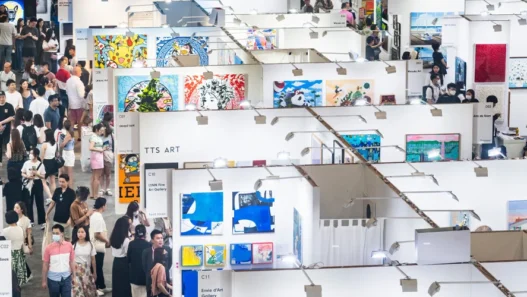
- Art Fairs: These, on the other hand, are market-oriented structures built around commerce, galleries, collectors, and visibility. The goal is transactions and business development. Even so, strong narratives, high production quality, and curatorial coherence matter more than ever, especially in specialized curated sections, emerging artist platforms, and focused thematic booths. While the final goal is a sale, the successful presentation is one that makes a compelling, gallery-backed statement.
Knowing this difference helps you avoid one of the most common mistakes: sending the same generic application or portfolio to both a conceptual biennale and a sales-driven fair. Your presentation must be tailored to the platform’s mission.
2. Build a Practice That Makes Sense Before You Apply
Applications rarely fail because the artists are “not talented enough.” They often fail because the practice isn’t yet articulated or focused enough for a professional selection committee to grasp quickly.
Before targeting any major opportunity, conduct an honest self-assessment by asking:
- Can I clearly explain what the core idea of my work is about in one sentence? Committees need instant clarity.
- Is there a visible, traceable thread connecting all my major projects? This demonstrates intellectual rigor and commitment.
- Does my work respond to a larger, verifiable context, be it social, political, material, scientific, or conceptual? Work that is isolated or purely personal rarely scales to an international platform.
Curators and selection committees are not looking for technical perfection; they are looking for clarity, commitment, and intellectual direction. A focused, thematic, and well-researched body of work is far more convincing and easier to contextualize than a scattered portfolio of unrelated pieces. Your application should be the summary of a journey already taken.
3. Research Is Not Optional, It’s the Core Strategy
Successful applicants do not send out hundreds of applications; they apply precisely and with surgical focus. A thoughtful proposal starts with obsessive research that establishes a clear, legitimate alignment between your work and the platform’s identity.
Strong research involves:
- Studying past editions of the biennale or fair: What were the central themes, and how were they realized?
- Identifying recurring themes and curatorial interests of the lead team: Who are the curatorial stars, and what kind of work do they champion?
- Noting which artists, galleries, and regional voices are consistently selected: Where does your work fit into the geopolitical and thematic puzzle?
- Understanding the specific geography, local politics, and intended audience of the event: How does the exhibition site affect the viewing experience?
When your work naturally, intentionally, and intelligently aligns with a platform’s established vision, your proposal reads as thoughtful, necessary, and strategic, rather than desperate or opportunistic. Applying without this foundational knowledge signals professional disengagement—and curators notice a lack of preparation instantly.
4. Target the Right Entry Points (Not Just the Main Exhibition)
The notion that an artist must enter the world stage through the main, marquee exhibition is a myth. In reality, most enduring international careers begin through alternative or auxiliary channels.
Actively look for and prioritize:
- Open calls linked to the biennale: Smaller, focused calls for specific projects or digital initiatives.
- Parallel or collateral exhibitions: Independent shows approved by and running concurrently with the main event, often showcasing regional talent.
- Emerging artist sections at art fairs: Focused, sometimes subsidized, platforms within the fair dedicated to younger or lesser-known artists.
- Curated booths or thematic platforms: Specific, non-selling sections of a fair dedicated to a scholarly theme.
- National or regional pavilions: Especially for artists whose work has a clear connection to a specific geography or cultural context.
- Artist-run or independent initiatives that have a historical or recognized connection to the event.
These spaces are often more experimental, flexible, and accessible. Critically, they are also frequently and intentionally visited by major curators, institutional directors, and influential collectors scouting for the next generation of talent. Start where you can make the biggest impression, not just the biggest name.
5. Writing a Proposal That Curators Actually Want to Read
A strong proposal is not poetic marketing text or an abstract manifesto. It is, first and foremost, a clear, grounded, and concise explanation of your project’s concept and logistics.
Effective proposals achieve two main goals simultaneously:
- They simplify the complex: They explain the core concept in clear, accessible language, avoiding excessive jargon or over-theorizing.
- They ground the abstract: They describe the materials, format, technical needs, and scale clearly and accurately, demonstrating feasibility.
Furthermore, they show an awareness of context and audience and explicitly connect the work to the event’s theme or mandate. Avoid vague language, emotional exaggeration, or hyperbolic claims about the work’s importance. Curators are reading dozens (sometimes hundreds) of complex applications. Clarity is kindness and professionalism. A curator should be able to visualize your entire installation after reading only the first two paragraphs.
6. Documentation Can Make or Break Your Application
Poor documentation is arguably the single biggest reason why strong, compelling artwork gets rejected. The most brilliant piece of sculpture or painting cannot be selected if the committee cannot accurately visualize it.
Your images and videos must function as a flawless translation of your physical work:
- Accurately represent scale and material: Use detail shots and include a simple object (like a doorframe or chair) to convey size.
- Show the work installed, not isolated: Include installation views that demonstrate how the work interacts with space, light, and architecture.
- Include details and context shots: Show close-ups that highlight texture, technique, and production quality.
- Be professionally edited, correctly oriented, and clearly labeled (captioned): Provide all necessary data (title, year, medium, dimensions).
Think of documentation as your work’s representative. If this representative is blurry, poorly lit, or misleading, the actual work will effectively disappear from consideration. Invest in quality photography.
7. Networking Without Selling Yourself
Networking, in the art world, is not about aggressive self-promotion or cold-calling. It is a long-term process of genuine, reciprocal relationship-building built on shared intellectual curiosity.
Meaningful connections are nurtured through:
- Actively attending talks, panels, and openings where curators and writers are present and engaging with their work.
- Asking thoughtful, well-researched questions during Q&A sessions that show you understand their specific interests.
- Following up with genuine interest in their projects, rather than immediately pitching your own.
- Supporting others’ work and being present over time, demonstrating that you are an engaged member of the community.
You don’t need to try and impress everyone you meet; you need to be remembered as thoughtful, engaged, and professional. Curators and institutions often invite artists they already trust and know to be reliable, not because of personal favoritism, but because large-scale exhibitions are logistically complex and fundamentally depend on reliable, communicative collaborators.
8. Work With Curators, Not Against Them
Many artists view curators as distant gatekeepers, but in the context of an exhibition, curators are essential collaborators and organizers. Changing this perspective is crucial for success.
If a curator shows interest in your work:
- Listen carefully to their questions and concerns: They are trying to find the best place for your work within a broader narrative.
- Be open to adaptation and compromise: Understanding that exhibitions are collective structures with specific spatial and thematic constraints.
- Respect deadlines and constraints meticulously: Missing a deadline can derail the installation schedule for the entire show.
- Maintain clear, professional communication: Address logistical concerns head-on.
Artists who are flexible, communicative, respectful of the process, and prepared are not only easier to work with but are far more likely to be invited again for future projects.
9. Rejection Is Normal, Silence Even More So
It is a statistical certainty that most applications will receive no response at all. This silence should not be taken as a personal slight or definitive critique.
Biennales and fairs are severely limited by a complex matrix of factors:
- Space and scale: Simply not having enough square footage for every compelling project.
- Budgets and logistics: Not having the funds to ship or install certain large-scale works.
- Institutional politics and thematic focus: The sudden need to shift focus due to external pressures or changing themes.
Rejection does not mean failure. Often, it means “not now,” “not this context,” or “we didn’t have space.” The work of the artist is to keep refining their practice and their articulation of it. Visibility is an asset that accumulates quietly, over years of consistent, high-quality output.
10. Think Long-Term, Not Event-Based
Getting into a biennale or major art fair is an incredible milestone, but it is not a finish line. It is one significant moment in a longer, more enduring professional trajectory.
What truly dictates a sustainable career trajectory is:
- Building a consistent, research-driven, and intellectually rigorous practice that can withstand critical scrutiny.
- Developing genuine, respectful curatorial and institutional relationships that lead to repeat invitations.
- Meticulously documenting and archiving your entire process (sketches, research notes, installation shots).
- Staying visible in thoughtful, strategic ways that align with your work’s values.
Careers are built through sustained, quiet continuity, not the buzz of single, isolated successes.
Biennales and art fairs are not closed worlds, but they are highly structured, professional ones. Artists and curators who take the time to understand the system, respect the complex process, and work with focused intention have a far greater, more predictable chance of entering it.
There is no shortcut. But there is a roadmap. And every strong application (built on research, clarity, and professionalism) is one step closer to being seen in the right place, at the right time.