





(A very human guide from one creator to another)
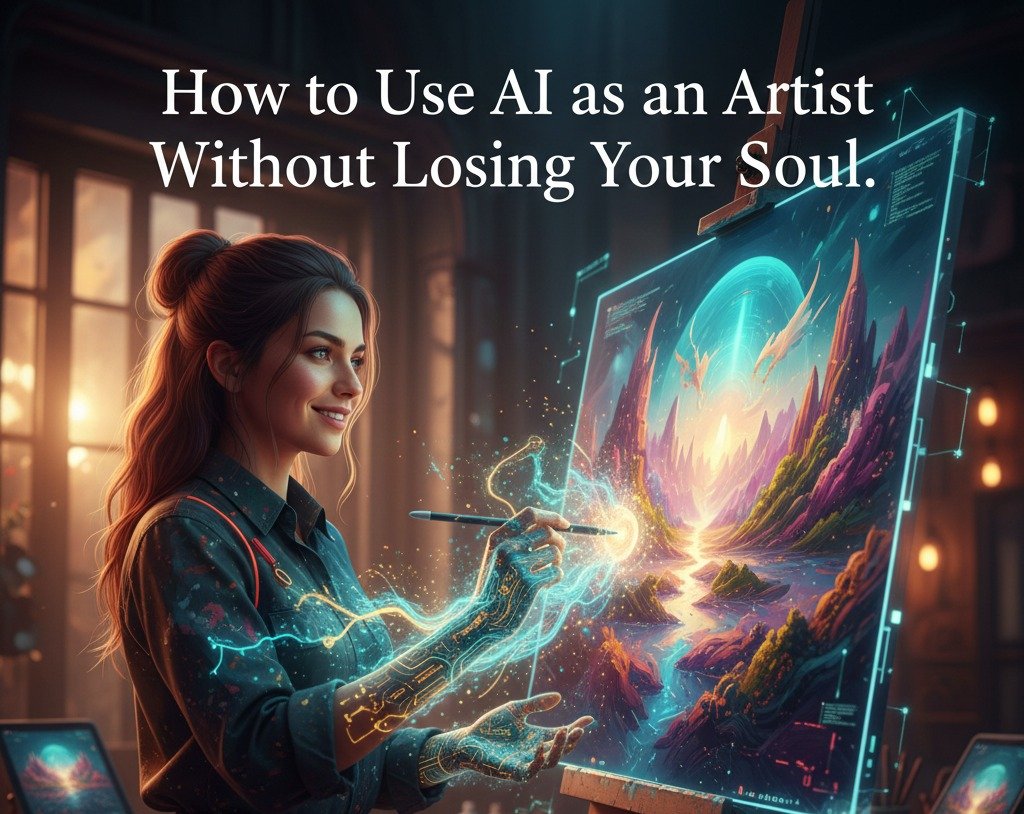
I’m an artist, just like you. Some days the ideas flow, some days the canvas stares back like it’s judging me. Lately, I’ve been letting AI sit in the studio with me, not to take my job, but to hand me brushes I never knew existed.
Here’s the truth: AI didn’t steal my creativity. It actually gave me more of it. But only because I set some rules for myself (rules I wish someone had handed me the first time I typed a prompt). These are the ones that kept me feeling like the work was still mine. 
1. Treat AI Like a Really Talented Intern
It’s fast, it’s full of surprises, and it will do exactly what you say, sometimes too literally. Your job is to be the boss: give it direction, question its suggestions, fire the bad ideas, and promote the good ones.
I start almost every project now by throwing messy sketches, mood photos, or half-written poems into Midjourney or Stable Diffusion. Ten minutes later, I have fifty directions I’d never have found alone. Then I close the laptop and pick the one that makes my stomach flip, the one that feels like my story. The rest get deleted without mercy.
2. Never Let It Finish the Sentence for You
I have a personal rule: AI is allowed to speak in the first draft only.
If I let it do the final rendering, I feel like I just posted someone else’s diary and signed my name at the bottom. So I print the AI image, throw it on the light table, and paint, draw, or collage over it until it looks like something only I could have made. The machine gave me the skeleton; I grow the flesh, the scars, the weird little details that are unmistakably human.
Some of my favorite pieces now are 90 % hand-painted on top of a 10 % AI underlayer. Collectors lean in close and whisper, “How did you do that texture?” I just smile. Trade secret: sweat, acrylic, and a rebellious heart.
3. Be Loud About the Process (or Quiet—Your Call)
I started putting a tiny “⚡ AI-assisted” note on the back of every piece that used it, the same way photographers used to write “gelatin silver print.” Some buyers love the honesty; some don’t even notice. Either way, I sleep better knowing I’m not pretending the lightning bolt was actually a paintbrush.
If the concept is literally about human-vs-machine (like my series on memory and digital ghosts), I put the whole workflow in the exhibition text. Transparency can be the artwork itself.
4. Don’t Steal Someone Else’s Soul to Feed the Machine
This one hurts to even say: please don’t type “in the style of [living artist who is struggling to pay rent]” and then sell it as your own. It’s not “referencing.” It’s identity theft with extra steps.
I only use models that are ethically trained (or I train my own LoRAs on my own archive). It takes longer, costs more, and sometimes the results are wonky, but at least I’m not building my castle on someone else’s graveyard.
5. Protect Your Own Work Like It’s Your Child
Nightmare scenario: you post your paintings online → someone scrapes them → three months later a generator spits out “your” style for $5 a pop.
So I watermark everything that leaves my studio, I use Glaze/Nightshade when I feel extra paranoid, and I only upload low-res previews. Annoying? Yes. Necessary? Also yes.
6. Remember Why We Do This
AI can give you a perfect sunset in 3.2 seconds.
But it can’t tell me why that sunset made me cry when I was nine, or how my grandmother’s hands looked holding seashells, or why I’m still angry about something that happened in 2017.
That stuff—the messy, inconvenient, deeply human stuff—is the only thing the machine can’t replicate. That’s your unfair advantage. Guard it.
A Love Letter to the Worried Painter Reading This
I was terrified the first time I hit “generate.” I thought, “If this thing can do it better, what am I even here for?”
Turns out the answer is simple: the machine can make a thousand beautiful images.
Only you can make the one that breaks someone’s heart in exactly the right way.
So go ahead, let AI carry the heavy boxes into the studio.
Just don’t let it sit in your chair.
You still belong there.
Always will.
(Now close this tab, open whatever tool feels fun today, and make something only you could make. I’ll be in my studio doing the same.)