





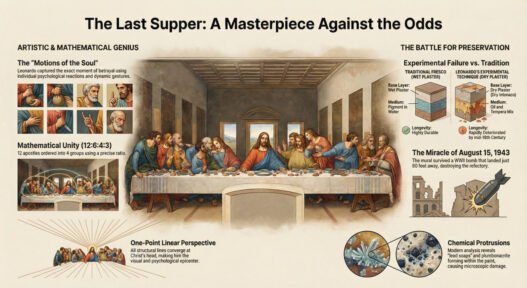
Leonardo da Vinci’s The Last Supper (c. 1495–1498) serves as the ultimate case study in Material Intelligence and Narrative Design. Beyond its religious significance, it is a masterclass in how an artist’s choice of medium can dictate the legacy (and the physical survival) of their work.
The Material Gamble: Tempera vs. Fresco
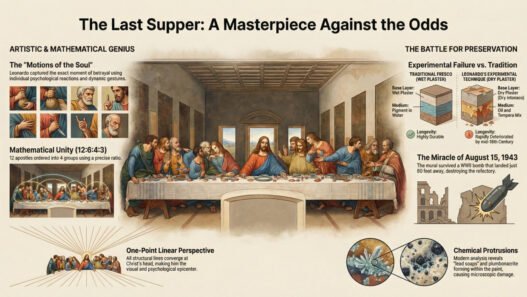
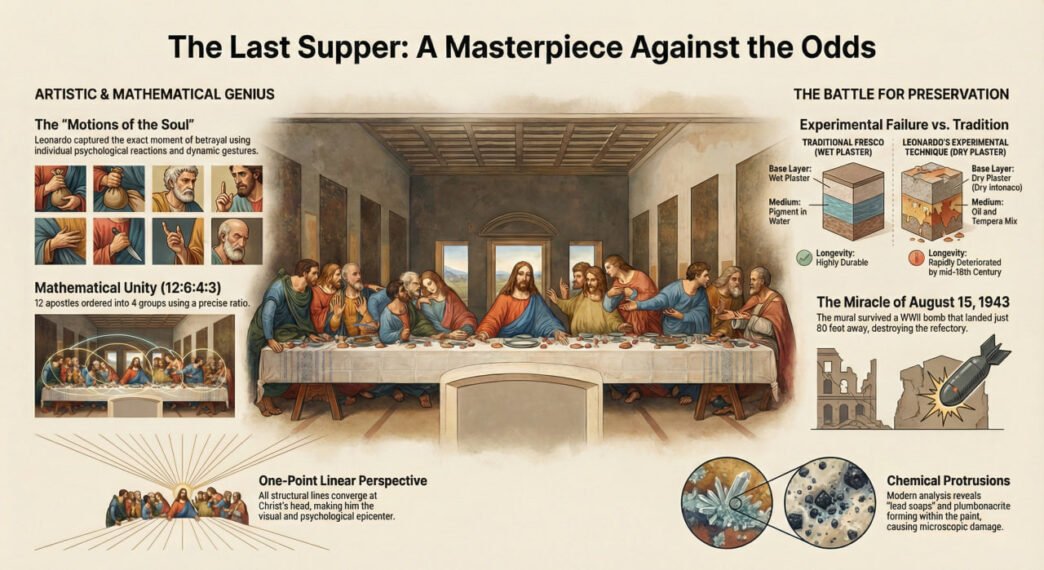
In a move that mirrors the experimental spirit of 2026, Leonardo rejected the traditional buon fresco technique (painting on wet plaster). He sought a richer chromatic range and the ability to make subtle, oil-like revisions, details that the fast-drying fresco process forbade.
- The Technique: He applied tempera and oil to a dry plaster ground.
- The Result: While this allowed for unprecedented psychological depth and luminosity, it was a “Material Intelligence” failure. Because the wall was damp and the medium didn’t bond with the stone, the painting began to deteriorate within years of completion.
- The Lesson for 2026: Even the most brilliant conceptual vision can be undermined by a lack of synergy between the medium and its environment.
Linear Perspective: The Invisible Architecture
Leonardo used the room’s architecture as an extension of the painting. The coffered ceiling and tapestries create orthogonal lines that converge at Christ’s head, making him the absolute vanishing point of the composition. 
- The Effect: This isn’t just a technical trick; it is a curatorial strategy to command the viewer’s eye. The refectory space of Santa Maria delle Grazie is “extended” into the painting, creating one of the earliest examples of an Immersive Installation.
The Four Groups: A Study in Human Drama
Leonardo eschewed static portraiture for a dynamic psychological study. He arranged the twelve apostles into four groups of three, creating a rhythmic wave of emotion that ripples outward from the serene center.
| Group | Key Emotion | The Story |
| Far Left | Shock | Bartholomew, James the Less, and Andrew react with sudden physical starts. |
| Middle Left | Indignation | Peter holds a knife (foreshadowing Gethsemane); Judas recoils into shadow. |
| Middle Right | Inquiry | Thomas, James the Greater, and Philip lean toward Christ in disbelief. |
| Far Right | Discussion | Matthew, Jude Thaddeus, and Simon discuss the news, seeking a rational explanation. |
The “Judas” Detail: Subtle Symbolism
Unlike previous artists who placed Judas on the opposite side of the table, Leonardo integrated him into the group. His identity is revealed through subtle “Material Cues”:
- The Shadow: His face is cast in a darker hue.
- The Overturned Salt: A symbol of bad luck or broken covenants.
- The Grip: He clutches the bag of silver, the physical weight of his betrayal.
Legacy and Preservation in 2026
Today, the work remains in a state of “permanent fragility.” For modern curators, The Last Supper is a reminder of the “Invisible Architecture” of Conservation. Its survival depends on sophisticated climate control, a precursor to the environmental standards we now apply to “Green Studio” practices.