





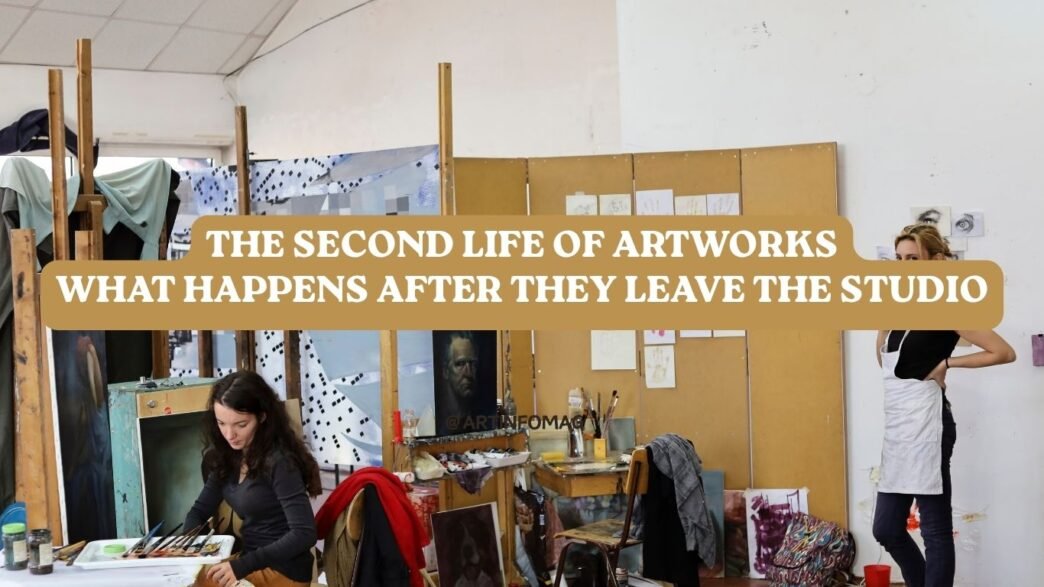
From gallery walls to private vaults, auction rooms to museum stores — a deep look at the journeys artworks take after leaving the artist, the rights artists retain, and the practical steps to protect and track a work across its lifetime.
The moment a work leaves the studio, the artist loses something they rarely get back: the ability to control what happens next. The painting is sold, the sculpture is shipped, the edition is distributed — and with that transaction begins a life the artist did not author, often cannot follow, and may never know the full shape of. Most artists do not think about this when they are making work. They should.
Understanding what happens to artworks after they leave the studio is not merely a legal or commercial concern. It touches on how work is preserved, how it is misread or recontextualised, whether the artist receives any financial benefit when its value grows, and whether any trace of its existence survives at all. This article maps the full journey — from the first sale to the deep archive — and identifies at every stage what artists can do to stay present in a work’s life, even after they have let it go.
Every artwork has two lives: the one it lives in the studio, and the one it lives in the world. Most artists devote everything to the first and almost nothing to preparing for the second.
The Journey: Stages in an Artwork’s Life After the Studio
An artwork’s trajectory after leaving the studio is not linear. It may move through several of the following stages, sometimes in sequence, sometimes simultaneously, sometimes repeatedly. Some works pass through all of them; many never leave the first.
| The Gallery — Primary Market | For most artists, the first life outside the studio is with a commercial gallery. The work is consigned or sold: displayed, offered to collectors, reviewed, and either purchased or returned. This stage can last days or years. In consignment arrangements, the artist retains ownership until sale — a legal distinction with practical consequences that many artists do not understand when they sign the agreement. |
| The Private Collection | The majority of sold artworks enter private collections and become, for practical purposes, invisible. They may be displayed in homes, stored in specialist facilities, lent occasionally to exhibitions, or simply held as financial assets. The artist typically has no right of access, no ability to photograph the work for their records, and no automatic notification if the work is resold. Some works spend decades here without the artist’s knowledge of where they are. |
| The Secondary Market — Auction & Resale | When collectors sell, works enter the secondary market — auction houses, dealer resales, private transactions. This is where prices can rise dramatically, where works gain or lose reputational weight, and where the artist, in most jurisdictions, receives nothing from the transaction. The secondary market generates the data that establishes an artist’s “market” — a construct that follows the artist for the rest of their career, accurately or not. |
| The Institution — Museum & Public Collection | Works acquired by public institutions enter a different kind of permanence. Museum acquisition is typically considered the highest form of validation in the Western art world — and also one of the most complex situations for artists. Works can be deaccessioned, stored indefinitely, displayed without context, or transferred to other institutions without the artist’s input. Institutional care standards vary enormously, and “permanent collection” is a more conditional term than it sounds. |
| The Archive — Documentation & Legacy | The final stage of most artworks is the archive: the documentation record, the catalogue raisonné entry, the digital image file, the provenance trace. For living artists, the archive is something to actively build. For estates, it is often the only remaining source of authority over how a work is identified, attributed, and valued. Works without documentation are works that can be lost, misattributed, or simply forgotten. |
| The Unlisted Path — Loss, Damage, Destruction | Not all works complete the journey. They are damaged in transit, destroyed in floods or fires, lost in estate clearances, discarded by heirs who do not recognise their value, or simply disappear from recorded history. The fragility of physical objects and the impermanence of private ownership mean that a significant proportion of artworks made in any era simply cease to exist. Documentation is the only partial defence against this. |
The Rights Artists Retain — and Those They Lose
The relationship between an artist and a work they have sold is governed by a patchwork of legal rights that vary significantly by country and are poorly understood by most artists at the moment of first sale. Understanding these rights is not a bureaucratic exercise — it is the foundation of an artist’s ability to remain present in a work’s life.
| Right | What it covers | Retained after sale? |
|---|---|---|
| Copyright | Reproduction, publication, derivative works | Yes — unless explicitly signed away |
| Moral rights | Attribution; right to object to derogatory treatment | Varies by country; can be waived |
| Resale royalty (droit de suite) | % of resale price on secondary market transactions | EU, UK, Australia: yes. USA, most others: no |
| Right of access | Ability to view, photograph, or study the work | No — only if contractually negotiated |
| Right of exhibition | Control over where and how work is displayed | No — collector controls display |
| Conservation approval | Input into how the work is restored or maintained | No — only if contractually negotiated |
| Attribution control | Ability to authenticate or deny attribution | Moral rights cover denial; authentication requires cooperation |
The most important of these — and the most consistently misunderstood — is copyright. An artist who sells a painting retains copyright in that painting unless the sale agreement explicitly transfers it. This means the buyer cannot reproduce the image commercially, include it in publications, or license it without the artist’s permission. In practice, most collectors do not know this, many galleries do not explain it, and many artists do not enforce it. The right exists regardless.
| 4% EU Resale RoyaltyArtists receive up to 4% on qualifying secondary market sales in European Union countries | 0% USA Resale RightNo federal resale royalty exists in the United States; California’s law was struck down in 2018 | 70+ Years of CopyrightCopyright in most countries lasts for the artist’s lifetime plus 70 years after death |
Practical Example: A Work’s Journey from Studio to Auction
The following scenario traces a single hypothetical painting through ten years of its post-studio life. It is fictional but composite — drawn from situations that recur regularly across the art market.
Scenario — Ten Years in a Work’s Life
2015. Studio to gallery. An artist completes a large-scale oil painting and consigns it to their commercial gallery under a standard agreement: 50/50 split, six-month consignment period, renewable. The agreement does not mention copyright, conservation rights, or resale terms. The work is priced at $8,000.
2016. Gallery to collector. The painting is purchased by a private collector for $8,000. The artist receives $4,000. The collector takes the work to a second home in another city. The artist is not given the collector’s contact details, has no high-resolution photographs of the finished work, and signs nothing that reserves any future rights.
2018. The reproduction problem. A publisher contacts the artist requesting a reproduction of the painting for an art book. The artist has only a low-resolution exhibition photograph. They have no contractual right to access the work. They spend three months attempting to locate the collector through the gallery, which has since changed representation. The painting misses the publication deadline.
2021. First resale. The collector sells the painting privately to a dealer for $24,000. The artist is not notified, receives no payment (outside EU/UK resale royalty territory), and learns of the sale two years later when the dealer’s invoice surfaces in an estate dispute. The artist’s market has effectively tripled without their knowledge or financial participation.
2023. Auction. The dealer consigns the painting to a regional auction house where it sells for $31,500. The auction catalogue lists the artist correctly but includes a brief biography with two factual errors that the artist cannot legally compel the auction house to correct. The work now appears in public auction records at this price — a data point that will follow the artist’s market permanently.
2025. The inquiry. A museum curator contacts the artist about including the painting in a survey exhibition. The artist does not know who currently owns it, cannot confirm its condition, and has no documentation adequate to support a loan agreement. The curator moves on to another work.
This scenario is not a worst case. It is a typical case. At no stage did anything illegal happen. The gallery was not negligent; the collectors were not malicious; the auction house followed standard practice. The problem is structural: artists enter the primary market without the documentation, contractual protections, or information architecture to stay present in a work’s life. What changes this is preparation, not luck.
What Artists Can Do: The Documentation Standard
The single most valuable thing an artist can do before any work leaves the studio is create a complete documentation record. This is not a bureaucratic formality — it is the instrument through which the artist remains connected to a work across decades and multiple owners.
| Artwork Documentation Record | Practical Template |
|---|---|
| Title | Exact title as it will appear in all records, sales, and exhibition labels |
| Date | Year of completion; note if work spans multiple years |
| Medium | Precise materials; for time-based or digital work, note format and specs |
| Dimensions | H × W × D in both cm and inches; for installation, include site dimensions and variable note |
| Edition info | If editioned: edition number, total edition size, APs if any |
| Signature | Where signed, how (front/back/base), date inscribed if applicable |
| Photography | Minimum: one high-resolution image (300dpi, longest edge 4000px+); detail shots; installation views if applicable. Store in at least two locations. |
| Certificate | Signed certificate of authenticity with all above fields plus artist’s studio address and contact at time of sale |
| Exhibition history | Log every exhibition, loan, and public display as it occurs |
| Provenance | Record each transfer of ownership with date, price (optional), and buyer/seller identity — as much as is available |
| Conservation notes | Any known vulnerabilities; recommended display and storage conditions; materials that require specific handling |
| Copyright statement | “Copyright © [Artist Name] [Year]. All reproduction rights reserved. Sale of this work does not transfer copyright.” |
Case StudyWhen the Certificate Decided the Estate
An artist dies in 2012, leaving an estate of approximately 400 works. The estate’s executor, a family member with no art world background, begins receiving authentication requests and resale inquiries within months. Of the 400 works, fewer than 80 have any documentation beyond the artist’s own studio lists — which are handwritten, inconsistently dated, and sometimes contradictory.
Over the following decade, 140 works appear on the secondary market. Of these, 23 are sold without any authentication process. Of those 23, at least six are later identified as misattributed: works by other artists, student works, or works the artist explicitly disowned. Each misattribution affects the market price of authenticated works, the estate’s credibility with institutions, and the historical record that will define the artist’s legacy.
The 80 works with documentation — exhibition records, gallery invoices, certificates — are cleanly tracked and in several cases acquired by public institutions. The undocumented 320 remain in legal and historical limbo. The difference is paperwork that would have taken the artist thirty minutes per work.
Contractual Protections Artists Can Negotiate
Documentation creates the record; contracts create the rights. Many artists are unaware that certain protections — beyond copyright — can be negotiated into sale agreements at the point of first transfer. These are not standard in the industry, which is precisely why they must be actively sought.
| ◈Right of Access Clause | Negotiated into the sale agreement: the artist retains the right to access the work for documentation, exhibition loan applications, or scholarly research, with reasonable notice. Rarely agreed to for high-value works but more commonly available for mid-market sales where collectors have personal relationships with artists. |
| ◈Conservation Consultation Clause | Requires the collector to consult the artist (or the artist’s designated representative) before any conservation or restoration work is undertaken. Particularly important for works using unconventional materials, time-based media, or processes that require the artist’s knowledge to restore correctly. |
| ◈Resale Notification Clause | The collector agrees to notify the artist if the work is offered for resale, giving the artist a defined window (typically 30–60 days) to exercise a right of first refusal at the intended sale price. More common in private sales than at auction. Useful for artists who may wish to reacquire works for significant retrospectives. |
| ◈Non-Derogatory Display Clause | Prohibits the collector from displaying the work in contexts the artist would find materially damaging — commercial advertising, political contexts, alongside works the artist finds incompatible. Rarely enforced but occasionally valuable. Linked to moral rights, where these exist in national law. |
| ◈Provenance Update Agreement | The collector agrees to provide the artist (or estate) with updated provenance information at intervals or upon resale, maintaining a continuous ownership record. The simplest and most commonly agreed of these clauses, requiring nothing from the collector but basic record-keeping. |
| ◈Voluntary Resale Royalty | Where no statutory resale right exists (as in the USA), a voluntary royalty clause can be written into the initial sale contract: the collector agrees to pay the artist a defined percentage (typically 3–10%) of any future resale price above the original purchase price. Enforceable between the contracting parties though not on subsequent owners without a chain of agreement. |
The Secondary Market: What Artists Should Know About Auction
The first time a work appears at auction is a significant moment in an artist’s market biography — and one the artist almost never controls or anticipates. Works come to auction without the artist’s knowledge, are given estimates based on market comparables the artist may disagree with, and are sold at prices that become permanent public data points regardless of whether the sale reflects the work’s quality or the artist’s current standing.
Artists who monitor their secondary market have an enormous informational advantage over those who do not. Auction results are publicly searchable through platforms such as Artnet, Artprice, and Invaluable. Setting up regular searches for your own name — including variant spellings — allows you to track where your work is, at what prices it is being valued, and whether it is being correctly attributed and described.
An artist who does not know their secondary market does not know their own history. Auction records are not someone else’s business — they are a significant part of your professional biography, being written without you in the room.
Institutional Collections: The Myth of Permanence
“Permanent collection” is an aspiration, not a contract. Public institutions deaccession works — removing them from their collections — more frequently than the public understands, and often without significant transparency. Deaccessioned works can be sold at auction, transferred to other institutions, or, in some historical cases, simply lost.
When a work is acquired by a public institution, artists should request — and can often obtain — a copy of the acquisition documentation, the agreed catalogue entry, and any conservation notes. Artists who maintain contact, provide installation notes, and offer documentation for reinstallations are the ones whose works are displayed rather than stored.
Building the Archive While You Can
The archive is not something to be left to an estate. Every artist with a body of sold or exhibited work has an archive problem they may not have identified as such: the absence of systematic records that will allow their work to be identified, verified, and contextualised when they are no longer able to provide that context themselves.
Building the archive is a living practice, not a posthumous one. It means maintaining a complete work log, photographing work before it leaves the studio, and understanding that the archive is not for the artist’s use alone — it is for every curator, scholar, collector, and future owner who will encounter the work in circumstances the artist cannot predict.
The Living Archive: What to Maintain While You Can
| ◆ A complete work log: every work made, with title, date, medium, dimensions, and current location if known |
| ◆ High-resolution photography for every sold or exhibited work, stored in at least two physical or cloud locations |
| ◆ Copies of all gallery consignment agreements, sale invoices, and exhibition loan agreements |
| ◆ Certificates of authenticity — your copy, permanently filed, for every work sold |
| ◆ A collector contact list, updated as works change hands where you are notified |
| ◆ Exhibition history for each work, logged as it occurs rather than reconstructed later |
| ◆ Copyright notices in all digital image file metadata and in sale documentation |
| ◆ Conservation notes for works with unusual materials or display requirements |
| ◆ A designated person who knows the location and access credentials for your archive |
| ◆ Periodic secondary market monitoring — a regular search of your name across public auction databases |
A Note on Digital and Time-Based Work
Everything in this article applies with greater urgency to digital, video, and time-based works — and with added complexity. Software becomes obsolete. File formats change. Hardware fails. The “original” of a digital work is a concept that requires active definition and defence, and the documentation standards for time-based media are substantially more demanding than for object-based work.
Artists working in digital and time-based media should develop — ideally with the support of a specialist conservator or organisation such as the Variable Media Network — an explicit migration strategy: a plan for how the work will be kept accessible as its original format becomes obsolete. Collectors and institutions who cannot or will not commit to supporting the migration plan should be considered carefully before a work is sold into their care.
Find Exhibitions, Residencies & Grants That Support Your Practice
ArtInfoLand connects artists with opportunities across 85+ countries — open calls, residency programmes, grants, and exhibition opportunities, updated regularly and filterable by discipline, location, and career stage.