




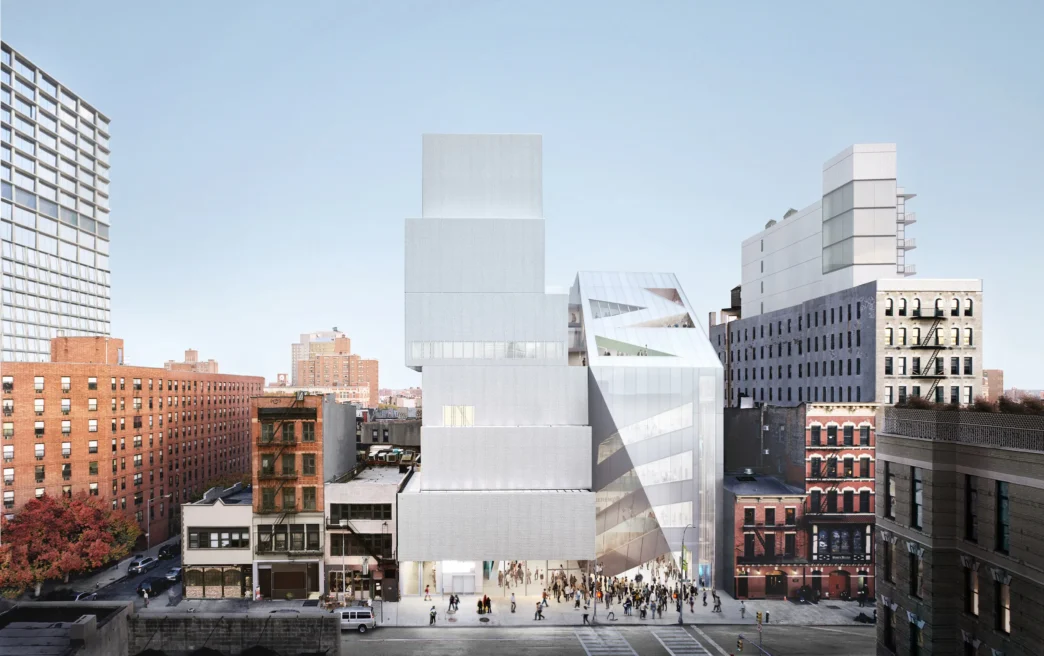
An $82 million transformation on the Bowery signals a new era for contemporary art in New York and the world.
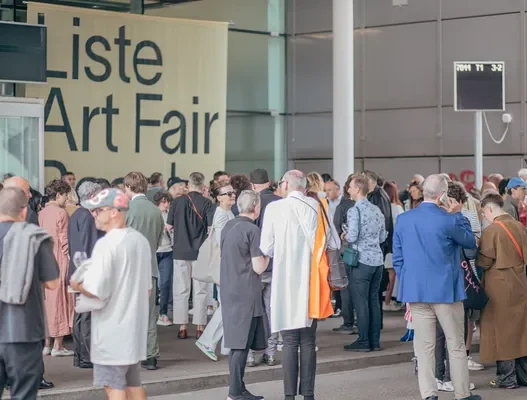
On the morning of Saturday, March 21, 2026, a line stretched the length of the Bowery. Art lovers, architecture enthusiasts, and the curious gathered outside a building that had been shuttered for nearly two years, waiting for a museum that had always punched above its weight to reveal just how much heavier it had become.
The New Museum, New York’s only institution dedicated exclusively to contemporary art, reopened its doors to the public that morning with a transformation as bold as the art it has championed since its founding in 1977. After a decade of planning, two years of construction, and an investment of $82 million, the museum has emerged not merely expanded but fundamentally reimagined.
“This is a great moment for us, and it’s a transformative moment for the museum and the city.”
— Lisa Phillips, Toby Devan Lewis Director, New Museum
A NEW BUILDING FOR A NEW ERA
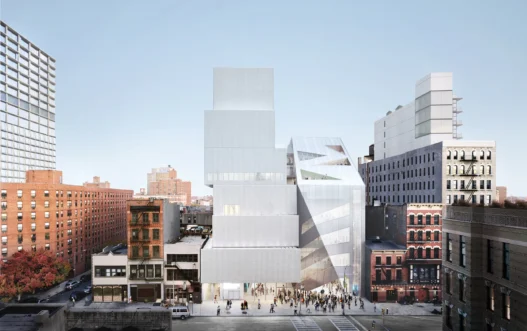
The expansion, designed by OMA (the internationally acclaimed office led by Rem Koolhaas and Shohei Shigematsu in collaboration with executive architect Cooper Robertson) adds nearly 62,000 square feet to the institution, effectively doubling its exhibition capacity and bringing the museum’s total footprint to approximately 120,000 square feet.
The architectural conversation at the heart of the project is one of deliberate contrasts. The original SANAA-designed tower, opened in 2007, is vertical and introspective: a stack of misaligned white boxes that became an instant icon of the Bowery’s transformation. The new OMA addition leans outward (horizontal, porous, and engaged with the street) its industrial lines juxtaposed against SANAA’s light-filled minimalism.
“We thought less about designing a single object and more about designing a pair,” explained Shigematsu at the press preview. Bridges, shared galleries, and a sweeping new atrium staircase stitch the two structures together, creating a museum that finally breathes. The new staircase alone (anchored by a monumental suspended sculpture by Czech artist Klára Hosnedlová) has already become a destination within a destination.
Beyond the galleries, the expansion introduces a 74-seat forum for talks and screenings, a new street-level entrance plaza, expanded studios for artists-in-residence, and a dedicated home for New Inc., the museum’s celebrated cultural incubator. A full-service restaurant (led by chef Julia Sherman of the Oberon Group) completes a campus that finally offers the full range of experiences expected of a world-class cultural institution.
NEW HUMANS: MEMORIES OF THE FUTURE
If the architecture announces a new ambition, the inaugural exhibition makes clear that the New Museum’s intellectual project has lost none of its urgency. Titled New Humans: Memories of the Future, the sprawling thematic survey was organized by the museum’s Edlis Neeson Artistic Director, Massimiliano Gioni, and spans the entirety of both buildings.
The exhibition brings together more than 200 artists, writers, scientists, architects, and filmmakers from over 56 countries, placing contemporary voices in dialogue with 20th-century figures to trace what Gioni describes as humanity’s enduring preoccupation with its own transformation. Early avant-garde visions of the “New Man” and “New Woman” appear alongside present-day explorations of artificial intelligence, bioengineering, and post-human futures.
The historical sweep is deliberately disorienting. Francis Bacon’s tortured human forms, Salvador Dalí’s dreamscapes, and Hannah Höch’s incisive photomontages share walls with multimedia installations by Sophia Al-Maria, whose work explores cultural dystopias and cyber-futures, and the collage-based narratives of Wangechi Mutu, who merges the human body with speculative ecological landscapes. Meriem Bennani, Philippe Parreno, and Precious Okoyomon are among the contemporary voices further expanding the exhibition’s dialogue across time and discipline.
“It’s great to offer an opportunity for people to see not only art, but to see art as a tool to interpret the times in which we live.”
— Massimiliano Gioni, Edlis Neeson Artistic Director
Nearly 20 new commissions were created specifically for the show, including permanent site-specific works that will remain with the building long after the exhibition closes: a façade installation by Tschabalala Self, and VENUS VICTORIA, an outdoor sculpture by Sarah Lucas for the entrance plaza, which marks Lucas as the inaugural recipient of the Hostetler/Wrigley Sculpture Award, a new biannual prize supporting major new works by women artists.
Critics have been largely enthusiastic. ARTnews praised the expansion as finally giving the museum “a building to match its ambitions,” noting that the new spiral staircase represents “a stroke of genius in terms of museum architecture” and that the art itself “looks so much better” in the expanded galleries than it ever did before.
AN END AND A BEGINNING
The reopening carries an additional layer of poignancy. Lisa Phillips, who has directed the New Museum for nearly three decades, will retire in April 2026, bookending her remarkable tenure with the completion of this expansion. Under her leadership, the museum consistently foregrounded emerging voices, risk-taking, and transdisciplinary practices, a vision that the new building is designed to carry forward.
The institution she leaves behind is one that has expanded not only in square footage, but in global reach and cultural ambition. With artists from more than 56 countries represented in a single inaugural exhibition, the New Museum is making clear that its next chapter will be written in an international register.
Opening weekend (March 21 and 22) was offered to the public free of charge, with advance tickets having sold out within hours of becoming available. Regular admission is now open, priced at $25 for adults, with discounted rates for students, seniors, and people with disabilities, free admission for visitors under 18, and pay-what-you-wish extended hours every Thursday evening.