





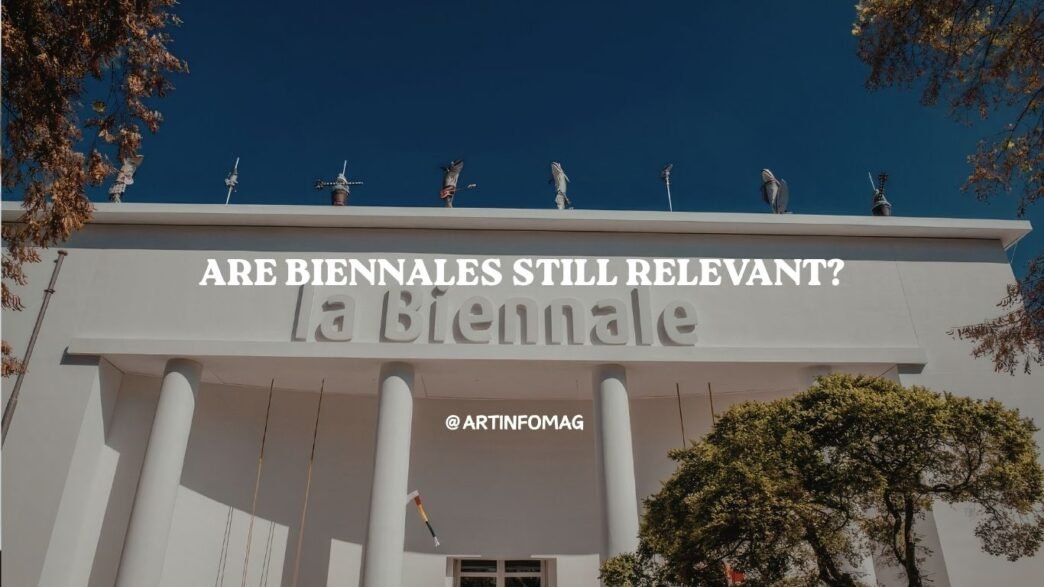
The biennale circuit once defined the contemporary art world’s global ambitions. Now it is being asked harder questions — about carbon footprints, institutional repetition, and whether a format born in 1895 can still do the work it claims to do in 2025.
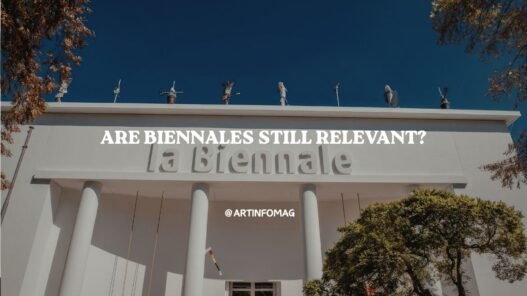
Every two years, the art world converges on Venice. Planes fill with curators, collectors, critics, and artists. Hotels charge four times their usual rate. The city’s narrow streets absorb an industry performing itself, and for a few weeks, the Giardini and the Arsenale become the closest thing contemporary art has to a world capital. Then it ends, and the question — whispered for decades and now spoken aloud — returns: what exactly was the point?
The biennale format is under pressure from multiple directions simultaneously. Climate activists point at the carbon cost of flying five thousand art world professionals to the same city twice a year. Decolonial critics note that the national pavilion structure was designed in an era of empire and has never fully shed those origins. Artists question whether a show that opens and closes in a matter of months, experienced by a self-selecting international audience, constitutes genuine public engagement. And a growing number of voices — from within the institutions themselves — are asking whether the biennale has become more about its own perpetuation than about the art it supposedly serves.
None of this means biennales are finished. It means they are at an inflection point — one that deserves a clearer analysis than the usual defences (“they introduce artists to global audiences”) or the usual dismissals (“they’re just expensive parties for the already-connected”). This article takes both the case for and the case against seriously, and tries to work out what the biennale format can still genuinely do — and what it can no longer credibly claim.
The biennale was invented to answer a question the nineteenth century was asking. The question has changed. Whether the format can change with it is the thing worth examining.
What Biennales Were Designed to Do
The Venice Biennale was founded in 1895 as a vehicle for national cultural prestige — a world’s fair for art, structured around the pavilions of sovereign states competing to display the vitality of their national cultures. The architecture of the Giardini literally embeds this logic: permanent buildings owned by individual nations, their flags flying at the entrance. It is not a neutral structure.
For much of the twentieth century, this national competition model served a recognisable function: it provided a regular international platform for artists who would otherwise have no mechanism for global visibility, and it created a shared reference point for an art world that was genuinely geographically fragmented. Before the internet, before the globalisation of the art fair circuit, the biennale was one of the only structures through which an artist working in São Paulo, Lagos, or Seoul could be seen by the same audience as one working in New York or London.
That world no longer exists. The infrastructure of globalised art — fairs, online platforms, international residency programmes, digital publishing — means that geographical isolation from the art world’s centres is no longer what it was in 1975 or even 1995. The biennale’s original justification has partly dissolved, and the format has had to reinvent itself around other claims: thematic urgency, curatorial ambition, and a kind of geopolitical commentary that the national pavilion structure simultaneously enables and undermines.
The Case for Biennales — Taken Seriously
The strongest defences of the biennale are not the ones most often made. The argument that biennales “bring art to a global audience” collapses under examination — the audience for any major biennale is overwhelmingly drawn from the art world’s existing professional and collector class, and the public who attends is largely the educated urban tourist, not the populations in whose name these events claim to speak.
The stronger arguments are more structural. Biennales create the conditions for ambitious, large-scale work that neither the commercial gallery system nor the collecting museum can regularly support. A significant number of the most formally adventurous works of the past three decades — works that could not be sold, could not survive long-term institutional collection, required specific spatial conditions or community contexts — were first realised through biennale commissions. The format funds experimentation that the market cannot.
Biennales also serve a less visible but genuinely important function as a mechanism for the redistribution of critical attention. A curator building an international survey exhibition for a biennale is doing research that actively goes looking for artists outside the established circuits — and the results of that research, when it is done seriously, introduce artists to professional networks and publication histories that have lasting effects on their careers. The curatorial essay in a biennale catalogue, unfashionable as it sounds, remains one of the most widely distributed forms of serious critical writing about living artists.
The argument that holds
Biennales fund work the market won’t. Large-scale commissions, durational projects, site-specific interventions, works that cannot be sold or stored — these forms of practice exist partly because biennale budgets make them possible. Remove the biennale circuit from the ecology of contemporary art production and you remove one of the few remaining structures willing to fund genuine formal risk.
There is also the question of what happens between professionals at these events — the conversations, introductions, and collaborations that take place alongside the exhibitions themselves. The art world runs substantially on relationships built in person, and biennales create concentrated conditions for those relationships to form. This is not a sufficient justification on its own, but it is a real function, and it is worth acknowledging honestly rather than dismissing as mere networking.
The Case Against — Also Taken Seriously
The criticisms of biennales are by now familiar enough that repeating them risks the appearance of performing criticality rather than exercising it. But familiarity does not diminish the substance of the problems, and several of them have grown more acute in recent years.
The proliferation problem is real and has consequences. There are now well over three hundred biennales worldwide. The majority of the curatorial, institutional, and critical attention available to the format is concentrated in fewer than twenty of them, leaving the rest functioning more as local cultural festivals with international pretensions than as genuine contributions to global art discourse. The proliferation has diluted both the meaning of the format and the quality of attention any individual event can expect to receive.
Criticism 01 — The Carbon Problem
The environmental cost of the biennale circuit is not incidental — it is structural. An event whose central function requires thousands of international professionals to fly to the same location, repeatedly, every two years, is an event whose format is in direct contradiction with the climate rhetoric that biennale catalogues increasingly contain. The gap between what biennales say and what biennales do on this issue has moved from ironic to untenable. Some biennales have begun carbon offsetting programmes; none has yet seriously reckoned with whether the format’s core model is compatible with the commitments the art world professes.
Criticism 02 — The Structural Repetition
The artists who appear in major biennales are drawn from an increasingly recognisable pool. Survey the participant lists of Documenta, Venice, Istanbul, São Paulo, and Gwangju over the past decade and you will find a significant overlap — a circuit of artists whose work circulates through the same institutional infrastructure, receives the same critical attention, and is ultimately purchased by the same collectors. The biennale system claims to disrupt art world hierarchies; in practice, it often consolidates them. The work that gets seen is the work that was already getting seen.
Criticism 03 — The Audience Fiction
Biennales routinely justify their existence in terms of public access and democratic cultural participation. The numbers are invoked — Venice receives over half a million visitors; Documenta in Kassel draws audiences from across Germany and beyond. But the experience of attending a major biennale, particularly in its opening weeks when critical attention peaks, is not a democratically accessible one. Ticket prices, travel costs, accommodation, and the social codes of the art world’s professional gathering mean that the people most represented at biennales are the people who are already inside the system. This is not unique to biennales — it is a problem across the cultural sector — but it is particularly acute in an event format whose self-justification depends so heavily on public reach.
What the Biennale Model Has Failed to Resolve
Underlying all of these criticisms is a structural tension that the biennale format has never fully addressed: it is simultaneously a site of critical inquiry and a vehicle for institutional self-reproduction. The same event that commissions work questioning the global art market is funded by collectors whose wealth depends on that market. The same curatorial framework that advocates for decolonial practice operates within a national pavilion structure that is a monument to colonial-era geopolitics. The same catalogue that makes the case for ecological urgency is printed in a run of thousands and shipped internationally.
This is not hypocrisy, exactly — it is the condition of all institutional critique practiced from inside institutions. But it is worth naming clearly because it shapes what biennales can and cannot honestly do. A biennale can commission work that criticises the systems that fund it; it cannot be those systems’ antidote. The distinction matters for evaluating what the format is actually for.
A biennale can commission work that criticises the systems that fund it. It cannot be those systems’ antidote. The distinction matters for evaluating what the format is actually for.
What Is Actually Changing — and What Isn’t
The most substantive changes in the biennale landscape over the past decade have come not from the major established events but from newer and smaller models that have taken the format’s premises more seriously. Several biennales in the Global South have developed genuinely localised curatorial methodologies — working with community organisations, commissioning work from artists who are not on the international circuit, building programming structures that persist between editions rather than disappearing with the closing ceremony. These are genuine innovations, and they point toward what the format can look like when its relationship to local context is understood as a feature rather than a complication.
The major established biennales have been slower to change. Venice remains structured around national representation in a way that no amount of curatorial framing can fully transcend. Documenta, despite its decennial ambition to reimagine the art world’s conditions from scratch, has repeatedly found that the institutional infrastructure around it is less reformable than its curators assumed. The gap between the ambitions articulated in biennale catalogues and the structural realities of how biennales actually operate has become one of the most reliable features of the format.
What has changed is the conversation. The questions being asked of biennales — about sustainability, about who they serve, about the relationship between their rhetoric and their reality — are being asked more loudly and from more directions than they were ten years ago. Whether those questions produce structural change or are absorbed into the format as another layer of critical performance is what the next decade will determine.
Three Models Worth Watching
Rather than asking whether biennales as a category are relevant, it is more useful to look at which models of the biennale are responding credibly to the pressures the format is under — and which are not. Three approaches stand out as genuinely attempting to answer the format’s most serious critics.
Model 01 — The Rooted Biennale
Genuine local embeddedness over international spectacle
Some biennales have made a deliberate choice to prioritise depth of local engagement over breadth of international reach. They work with community organisations across multiple years, commission artists with genuine relationships to the host context, and build programming that exists between editions. The result is less spectacular but more durable — and more honest about who the event is actually for.
Model 02 — The Extended Biennale
Multi-year programming rather than episodic spectacle
A growing number of events are moving away from the concentrated spectacle model toward programming that stretches across the full two-year cycle rather than clustering it into a single intensive opening period. Residencies, commissions, publications, and public programmes that develop over time rather than appearing fully formed — and then disappearing — for a ten-week run. This model is less legible to the art world’s attention economy but more useful to the artists it involves.
Model 03 — The Honest Biennale
Transparency about what the event is and is not
The least glamorous model and perhaps the most promising: a biennale that is transparent about its own structural limitations, honest about its audience, and modest about its claims. That does not pretend to speak for communities it does not represent, does not claim ecological virtue while flying its entire curatorial team around the world, and does not produce catalogue texts about dismantling the systems it is funded by. The gap between language and practice is the thing that erodes the format’s credibility fastest; closing it, even partially, is more valuable than any curatorial theme.
What Artists Actually Get from Biennales and What They Don’t
For artists, the biennale question is less philosophical and more practical: does participation in a major biennale actually advance a career, and under what conditions? The answer, based on the evidence of the past two decades, is: sometimes, for specific types of career, at specific moments — and far less reliably than the mythology suggests.
The artists who benefit most from biennale participation are mid-career artists whose work already has an institutional profile but who have not yet achieved significant international visibility. For these artists, inclusion in a major biennale — particularly Venice, Documenta, or a well-regarded regional event with strong curatorial networks — can produce lasting career consequences: catalogue documentation, critical writing, collector relationships, and curatorial attention that outlasts the exhibition itself.
The artists who benefit least are early-career artists included in large group exhibitions where their work is one of fifty or sixty. The visibility produced by a biennale group show is often less significant than artists expect, particularly for those whose practices are not yet developed enough to hold their own in a very large context. The commission fee and the catalogue entry are real benefits; the career transformation is frequently overstated.
Established artists — those whose work is already circulating through major institutions — often have ambivalent relationships with biennales. The time cost of participating in a large-scale international exhibition, the logistical demands of transporting or producing work, and the diffuse critical context of a mega-exhibition are frequently described as disadvantages. Some artists at this stage actively choose to limit biennale participation, preferring more focused institutional contexts where their work can be read with greater care.
The Answer — Which Is Not a Simple One
Are biennales still relevant? The answer is that they remain relevant in ways they do not always acknowledge and irrelevant in ways they have difficulty admitting.
They are relevant as funding mechanisms for ambitious work that the market cannot support. They are relevant as research processes — curatorial investigations that actively go looking for artists outside established circuits. They are relevant as generators of critical writing and documentation. They are relevant as occasions for professional encounters that have lasting consequences. These are genuine contributions to the ecology of contemporary art.
They are not relevant — or at least not credible — as mechanisms for democratising access to art. They are not credible as vehicles for the political and ecological transformation their catalogues increasingly advocate. They are not functioning well as mechanisms for disrupting the art world hierarchies they claim to challenge. And the model of the concentrated international gathering, in an era of climate crisis, is under a pressure that cannot be resolved by better press releases about carbon offsetting.
The biennales most worth attention in the coming decade are likely to be the ones that are honest about this — that identify what they can genuinely do and do it well, without claiming to be what they are not. The format is not finished. But the version of it that operates primarily as a vehicle for the art world’s self-celebration, wrapped in the language of urgent political purpose, is harder to defend with each passing edition.
The biennales most worth defending are not the ones making the largest claims. They are the ones doing something specific well — funding work that wouldn’t otherwise exist, building relationships that outlast the opening week, and being honest about what they are not.
Find Open Calls, Residencies & Biennale Opportunities
ArtInfoLand lists opportunities across 85+ countries — including biennale open calls, residency programmes, and exhibition opportunities. Find the programmes genuinely right for your practice.