





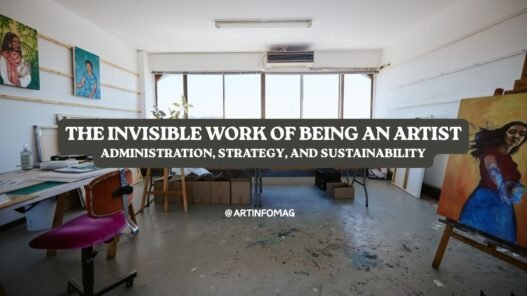
Administration, Strategy, and Sustainability
No one teaches you the other half of being an artist — the proposals, the spreadsheets, the emails, the strategy. This guide names it, maps it, and shows you how to make it take less time and cost you less energy.
There is the work — the paintings, the films, the performances, the sculptures, the scores. And then there is the other work: the applications, the budgets, the emails to curators, the artist statements drafted at midnight, the spreadsheets tracking which galleries have which pieces, the tax returns, the grant research, the Instagram posts, the database of collectors who might be interested, the follow-up that never got sent. Most artists spend between thirty and fifty percent of their professional time on this second category of work. Almost none of them were trained for it.
This article names the invisible work of being an artist, maps its main domains, and offers practical frameworks for managing it without letting it swallow the studio practice it is supposed to support. It is not a guide to becoming a business. It is a guide to running a sustainable artistic practice — which, it turns out, requires some of the same skills.
The studio is where the work gets made. Everything outside it is the infrastructure that keeps the studio open. Both matter. Neither should dominate.
Why No One Talks About the Administrative Life of Artists
Art school teaches you to make work. Critics teach you to talk about it. Galleries teach you — sometimes, if you are lucky — a little about how the market works. Nobody teaches you to manage a practice.
Part of the silence is cultural. There is a persistent mythology in Western art that administrative work and commercial thinking are corruptions of artistic purity — that the real artist exists above the transactional concerns of ordinary professional life. This mythology is mostly held by people who have never had to pay their own studio rent. It is also, quietly, a class marker: artists with financial cushions or institutional support can afford the performance of pure practice. Artists without those resources either learn to manage their practices or leave the field.
The other part of the silence is that administrative work in an art career is genuinely varied and context-specific — what a sculptor needs to track is different from what a performance artist needs, which is different again from what an illustrator or a public artist or a video artist needs. There is no single textbook. What there are, across all of these contexts, are recurring domains of invisible work that every artist eventually has to navigate.
The Six Domains of Invisible Work
The administrative life of an artist can be mapped across six overlapping domains. Understanding them as distinct — even when they bleed into each other in practice — makes it possible to think strategically about each one, rather than treating them as an undifferentiated pile of tasks.
| 01 Documentation | Photography, work logs, certificates of authenticity, archive maintenance, provenance records, exhibition history per work |
| 02 Applications | Grant writing, residency applications, open call submissions, prize applications, artist statements, CVs, portfolios, project proposals |
| 03 Financial Management | Invoicing, tax preparation, expense tracking, income diversification, sales records, pricing strategy, budget forecasting |
| 04 Relationships | Gallery relationships, collector contacts, curator outreach, press and media, peer networks, institutional contacts, collaboration management |
| 05 Presence | Website maintenance, social media, press releases, exhibition texts, artist biography, newsletters, publication submissions, online portfolio |
| 06 Strategy | Career planning, opportunity research, market positioning, long-term income modelling, studio sustainability, five-year thinking |
Most artists are strong in one or two of these domains and systematically neglect the others. A painter might document work meticulously but never send a single targeted outreach email to a curator. A performance artist might have an excellent professional network but no financial records that would survive a tax audit. Identifying your specific weak domains — honestly — is the first practical step toward managing the invisible work.
The Time Problem — and What Actually Fixes It
The most common complaint about administrative work among artists is not that it is difficult — it is that it is endless. There is always another application to write, another email that hasn’t been sent, another invoice that is late. The pile never empties. For many artists, the result is a chronic low-grade guilt about the tasks not done, which ironically makes it harder to be present in the studio.
The solutions that actually work are not motivational. They are structural. Three in particular make a measurable difference.
| Fix 01Scheduled blocks, not open intentions | Administrative work expands to fill unstructured time and contracts when given a fixed window. One three-hour block per week — blocked in the calendar, treated as a studio session — handles more than five hours of fragmented reactive work. The block is not for doing everything. It is for doing this week’s most important task and one ongoing maintenance item. |
| Fix 02A master document, not scattered files | Most artists spend significant time searching for things they have already written — the artist statement from 2022, the bio that was the right length, the project description for the residency that asked for 200 words. A single master document containing all versions of your key texts, updated after every significant application, eliminates this entirely. It takes thirty minutes to set up and saves hours per year. |
| Fix 03Batching, not constant switching | Application writing, email correspondence, financial recording, and social media management each require a different cognitive mode. Switching between them constantly creates overhead that exhausts far more energy than the tasks themselves require. Batching — doing all the email in one session, all the financial recording in another — is not a productivity hack. It is a way of protecting the deep attention that both studio work and good writing require. |
The Application Economy: Strategy Over Volume
Grant writing and residency applications represent the largest single block of administrative time for most artists at the early and mid stages of their career. They also represent one of the areas most susceptible to a harmful approach: applying to everything, tailoring nothing, burning time on low-probability targets while neglecting the applications with the best fit.
The strategic approach to applications is counterintuitive: apply to fewer opportunities, more carefully. A well-researched, genuinely tailored application to a program that is an excellent fit for your practice has a success rate dramatically higher than a generic application sent to thirty programs. The time saved by not applying to poor-fit opportunities more than compensates for the additional effort of tailoring the good-fit ones.
Practical Example — The Application Pipeline
Imagine two artists applying for residencies over one year. Artist A applies to 30 programs using a mostly generic application, customised lightly for each. Artist B applies to 10 programs, spending twice as long on each application researching the program’s history, reading past residents’ work, and tailoring the proposal directly to what the program values. Artist A has a 3% acceptance rate — one residency. Artist B has a 20% acceptance rate — two residencies, with less total time spent on applications.
The numbers are illustrative, not precise — but the pattern is consistent. Targeted applications outperform volume applications, and the selection process itself — deciding which 10 to apply to — forces a level of strategic clarity about your practice and its direction that has value well beyond any individual application outcome.
Building Your Application Infrastructure
The most time-consuming part of any application is not writing — it is assembly. Finding the right images, remembering what the CV said last time, locating the version of the project description that was the right length. Building an application infrastructure means having all of this assembled, maintained, and ready so that the actual work of an application is the thinking and tailoring, not the searching.
| Component | What to maintain |
|---|---|
| Artist statement | Three versions: 100 words, 250 words, 500 words. Updated after any significant new body of work. Dated so you know which is current. |
| Biography | Third-person. Three versions: one sentence, one paragraph, two paragraphs. Keep a first-person version for artist statements that require it. |
| CV | One master CV, updated after every exhibition or significant event. A shortened version (1 page) for applications that require it. |
| Project descriptions | For any project you apply for regularly: a 100-word and 300-word version. For past projects: a single paragraph suitable for portfolio context. |
| Image library | High-resolution (300dpi+) images of every significant work, named consistently (ArtistName_Title_Year.jpg), in a single folder. A separate folder of installation views and process images. |
| References | A list of five people who have agreed to provide references, with their current title, institution, email, and a note on how they know your work. Updated annually. |
| Application log | Every application submitted: program name, date, what was submitted, outcome, notes. Invaluable for pattern recognition and for avoiding repeat applications to programs that rejected you recently. |
Financial Management: The Part Artists Avoid the Longest
Financial avoidance is one of the most common and most consequential patterns in artistic practice. Artists who do not track their income and expenses do not know their actual financial situation — they estimate it, usually optimistically, which leads to decisions that undermine the sustainability of the practice they are working to protect. The anxiety about not knowing is almost always worse than the reality of knowing.
The financial management of an art practice does not require an accountant, at least not initially. It requires four things: a record of income, a record of expenses, an understanding of tax obligations, and a rough model of sustainability.
Practical Example — The Income Map
A mid-career sculptor maps her income sources for the previous year. Sales of work: €9,200. Teaching (two part-time contracts): €18,400. Grants and residency stipends: €4,800. Public art commission: €6,000. Total: €38,400.
When she maps the time spent against each income source, a different picture emerges. Sales required an estimated 40 hours of studio, documentation, and relationship work per €1,000 earned. Teaching required 8 hours per €1,000. The grant was 60 hours of application work for €4,800 — €80 per hour. The commission was the most time-intensive but also the most publicly visible.
This map is not an argument against any particular income source. It is a tool for making conscious decisions. She decides to negotiate a third teaching contract, target one larger commission rather than three smaller ones, and reduce grant applications to the two programs with the best fit. Her total income rises the following year; her administrative time falls significantly.
The Income Diversity Principle
Sustainable artistic practices almost never run on a single income stream. The artists who remain financially stable over a career — not wealthy, but stable — almost all have a diversified income structure that combines earned income (sales, commissions, fees) with non-earned income (grants, fellowships, prizes) and earned service income (teaching, residency facilitation, critical writing, consulting).
| Income Type | Examples | Characteristic |
|---|---|---|
| Earned — Practice | Sales, commissions, licensing, edition sales, public art fees | Unpredictable; high variation year to year; grows with reputation |
| Earned — Service | Teaching, workshops, artist talks, curation, critical writing, arts consulting | More predictable; trades time directly; risk of crowding out studio |
| Non-earned | Grants, fellowships, prizes, residency stipends, crowdfunding | Competitive; requires investment to apply; ideally protects studio time |
| External employment | Part-time work unrelated to practice; freelance work in adjacent fields | Most stable; highest time cost; best treated as a temporary structure, not a permanent one |
The goal of income diversification is not to maximise income — it is to reduce dependence on any single source so that the loss of one (a gallery relationship ending, a grant not coming through) does not collapse the entire practice. Two or three income streams, thoughtfully chosen and actively managed, create more stability than five or six managed reactively.
Professional Relationships: The Long Game
Art careers are built on relationships — with galleries, curators, collectors, peer artists, critics, institutions, and funders. This is not a cynical observation about networking; it is a description of how the art world actually operates. Opportunities flow through trust built over time, and trust is built through consistent, genuine professional engagement — not through a single impressive meeting or a well-crafted email blast.
The most common mistake artists make in managing professional relationships is treating them transactionally — only reaching out when they need something. The alternative is not difficult: it is staying in light contact, sharing work when it is genuinely relevant to a curator’s interests, acknowledging when someone’s work has influenced your own, responding to emails thoughtfully and promptly. None of this is performative. It is the professional equivalent of being a good colleague.
Practical Example
An artist keeps a simple contact list of twenty people whose work and position she genuinely respects — curators, critics, collectors, peer artists. Once a quarter, she spends two hours reviewing it: has anything happened in her practice that is genuinely relevant to any of them? A new body of work that connects to a curator’s ongoing research. A residency that one of her peers might be interested in. A publication she thinks a collector would find meaningful. She sends four or five short, specific, non-asking messages. Over five years, this practice has produced three solo exhibition invitations, two significant collector relationships, and one major grant letter of support — none of which were the result of a formal pitch.
The Strategy Question Most Artists Never Ask
Strategy, in the context of an art practice, is not about brand positioning or market targeting. It is about answering one question: What does a sustainable, satisfying practice look like in five years — and what decisions now point toward that, rather than away from it?
Most artists manage their practices reactively. They apply for what comes up. They take work when it is offered. They respond to the art world’s agenda rather than setting their own. This is understandable — opportunities are scarce, and saying no to any of them can feel reckless. But reactive management produces practices that drift away from the artist’s core intentions, accumulate commitments that don’t cohere, and deplete energy without building toward anything.
The most important question in practice management is not “what should I apply for this month?” It is “what kind of practice do I want to have, and does this opportunity move me toward it or away from it?”
Practical Example: The Annual Practice Review
Once a year — many artists do this in January or after a significant show — spend two hours answering the following questions. Not as a performance review, but as an honest conversation with yourself about where the practice actually is and where you want it to go.
| Annual Practice Review — Questions | |
|---|---|
| Studio | What did I make this year that I’m genuinely proud of? What did I avoid making, and why? What direction is the work pointing that I haven’t fully followed yet? |
| Financial | What was my total income? What were my income sources? Which took the most time per dollar/pound/euro earned? Is this sustainable for another year? For five years? |
| Applications | How many applications did I submit? How many succeeded? What was the pattern of what succeeded and what didn’t? Am I applying to the right programs? |
| Relationships | Which professional relationships deepened this year? Which did I neglect? Are there people I respect whose work connects to mine that I haven’t reached out to? |
| Energy | What commitments cost more energy than they returned? What gave me energy? What did I say yes to that I should have said no to — and what does that pattern tell me? |
| Next year | What is the one thing I want to be different about my practice this time next year? What is the single decision I could make now that would most move toward that? |
Sustainability Is Not a Goal — It Is a Practice
Sustainability in an artistic practice is not a destination you arrive at. It is not a number in a bank account or a particular gallery representation or a certain level of grant success. It is a set of habits, structures, and decisions that make it possible to keep making work — under conditions of financial uncertainty, institutional indifference, and the ordinary difficulties of creative life — without burning out, giving up, or gradually hollowing out the practice until it is unrecognisable from the outside and empty from the inside.
The invisible work of administration, when done well, is what creates sustainability. Not because spreadsheets are intrinsically meaningful, but because knowing where you stand financially means you can make decisions from reality rather than anxiety. Because having your application infrastructure ready means you can apply to the residency you actually want rather than the first one with a deadline you can meet. Because maintaining your professional relationships means that when an opportunity arises that is genuinely right for your practice, you are already in the room.
The Invisible Work Starter Checklist
| → Create a master document with all versions of your key texts (statement, bio, project descriptions) |
| → Set up a simple income and expense tracking system — even a spreadsheet works |
| → Organise your image library with consistent naming and folder structure |
| → Start an application log — every submission, every outcome |
| → Block one administrative session per week in your calendar and treat it as fixed |
| → Map your income sources against the time they require — at least once |
| → Identify the two or three professional relationships most worth investing in this year |
| → Do the annual practice review — even just the first three questions |
| → Decide which domain of invisible work you have been most avoiding — and start there |
The artists who have long, sustained practices are not the ones who avoided the administrative work. They are the ones who figured out how to do it in a way that protected the studio rather than competing with it.
Find Grants, Residencies & Open Calls Worth Applying To
ArtInfoLand lists hundreds of opportunities across 85+ countries — filterable by discipline, career stage, location, and financial support. Find the programs that are genuinely right for your practice.