





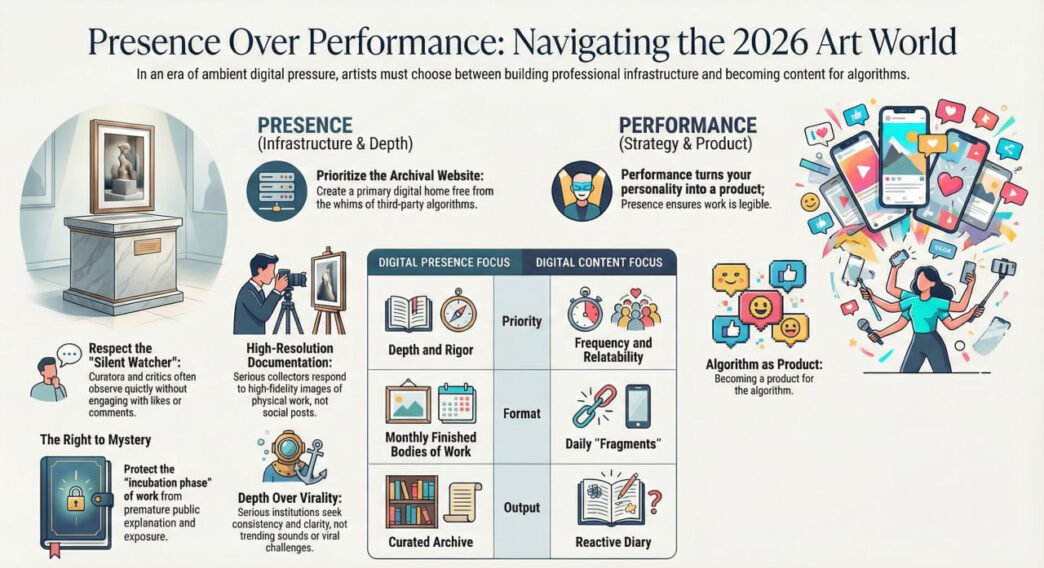
In the art world of 2026, visibility is no longer a luxury; it is a constant, ambient pressure. Artists are bombarded with advice to “post regularly,” “reveal vulnerability,” and “optimize for engagement.” The underlying fear is subtle but paralyzing: If you are not visible, you are disappearing.
However, there is a profound difference between having a Digital Presence and becoming Digital Content. One serves the work; the other exhausts the artist. To survive this era, we must distinguish between artistic communication and the endless production of entertainment.
1. Presence vs. Performance: Drawing the Line
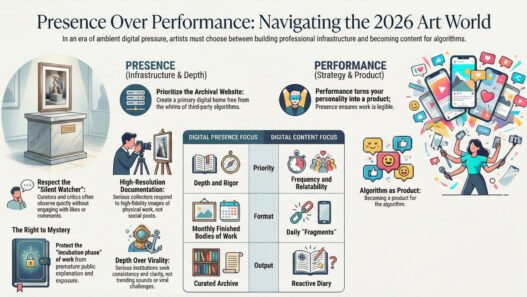
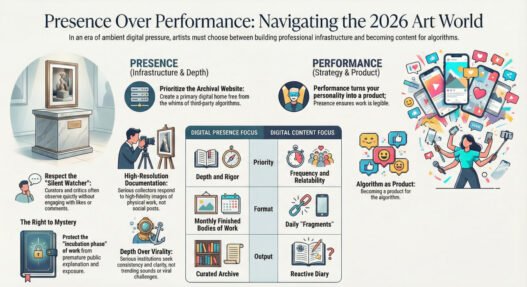
An online presence is infrastructure. It ensures your work can be found, your ideas are legible, and your practice is accessible to curators and collectors who observe quietly from the sidelines. 
Performance, however, is strategy. It is when your personality becomes a product and your studio becomes a stage. The algorithm rewards frequency and relatability, but art rewards depth and rigor. When you begin to ask “Will this perform well?” instead of “Is this direction honest?”, you have moved from presence to performance.
2. The Right to Mystery: Protecting the Incubation Phase
The digital culture of 2026 demands total transparency. We are told to document every failure and explain every concept prematurely. But not all practices benefit from exposure.
Some ideas need silence to form. They are fragile and can collapse under the weight of premature public explanation. Mystery is not inauthenticity; it is a professional necessity. Artists must protect the “incubation phase” of their work. You do not owe the internet continuous access to your private process.
3. Strategic Slowness in a High-Speed System
The digital environment favors the immediate. But serious artistic development rarely happens in real-time. Building a presence without becoming content requires Intentional Slowness:
- Quality over Cadence: Posting once a month with a finished, high-quality body of work is more effective for building a reputation than daily “fragments.”
- Editorial over Reactive: Treat your feed as a curated archive, not a diary.
- Depth over Virality: Remember that the curators and institutions you want to reach are looking for consistency and clarity, not a trending sound or a viral challenge.
4. Infrastructure vs. Noise: The Professional Toolkit
Your online presence should function as a solid foundation that supports your career even when you are offline. Instead of chasing engagement metrics, focus on Professional Infrastructure:
- A Clean, Archival Website: This is your primary home, free from the whims of third-party algorithms.
- High-Resolution Documentation: Serious collectors don’t acquire “posts”; they respond to high-fidelity images of physical work.
- Contact Accessibility: Make it easy for a curator to reach you without navigating through a sea of DMs.
5. The Psychology of the “Quiet Audience”
One of the most misunderstood aspects of social media is the “Silent Watcher.” The people who matter most to your career (museum directors, major collectors, and critics) often observe without liking, commenting, or sharing.
They are looking for reputation, not reach. A feed that remains focused, professional, and intellectually honest builds a much stronger long-term “Market Value” than one that chases the temporary affirmance of high engagement.
6. Reclaiming the Narrative: The Artist as Author
Instead of asking what the algorithm wants, ask: What do I want to communicate? An online presence can be an editorial act. You can share a research insight, a reflection on a material, or a formal exhibition announcement. By setting boundaries on what is public and what remains private, you reclaim control. You are the author of your digital archive, not a performer inside someone else’s system.
Visibility should serve the work, not replace it, distort it, or exhaust it. The strongest digital presence in 2026 is not the loudest; it is the most coherent. Your practice existed before the platform, and its value is not determined by a spreadsheet of engagement rates.
Keep the camera off until the work is ready. In the end, institutions archive your contribution to culture, not your ability to trend.