





For decades, the press release has been the undisputed gatekeeper of art world information. It served a simple purpose: to tell the public what to see, how to feel about it, and why it was worth a certain price. But as we move through 2026, the traditional press release is facing a crisis of terminal exhaustion. In an era of “content saturation” and AI-generated marketing copy, the audience has developed a high-level immunity to promotional jargon.
The result? A profound shift toward Critical Essays, writing that provides intellectual value, historical context, and honest inquiry rather than mere salesmanship. For the Artinfoland writer, this isn’t just a stylistic choice; it is a professional necessity. To be relevant in 2026, art writing must move from being a “marketing tool” to becoming a “knowledge asset.”
1. The Fatigue of the “Adjective-Heavy” Narrative
The traditional gallery press release is notorious for its “International Art English” (IAE), a dialect characterized by dense, abstract nouns and hyperbolic adjectives like transformative, subversive, or groundbreaking. In a digital-first market, this language has lost its power. 
- The Problem: When every exhibition is “groundbreaking,” nothing is. Readers now scan past these descriptions, searching for a “hook” of actual substance.
- The Critical Pivot: Instead of using adjectives to tell the reader the work is important, use analysis to show them. A critical essay replaces “This work is a subversive take on domesticity” with a deep dive into the specific materials, the artist’s lineage, and the psychological friction the work creates in the room.
2. Providing “Intellectual Value” as a Service
In 2026, the art writer’s role is closer to that of a researcher than a publicist. The audience (ranging from mid-market collectors to neurodiverse students) is looking for Intellectual Value. They want to know how a specific exhibition fits into the broader cultural currents of the year, such as “Material Intelligence” or the “Post-Digital” shift.
- Contextual Framing: A critical essay links the work to external worlds, politics, science, or philosophy. If you are writing about a 2026 light installation, don’t just describe the colors. Discuss the “Bio-Sync” technology used and how it relates to our current collective need for sensory havens. This turns the essay from a “flyer” into an “educational resource” that a collector will want to archive.
3. The “Honest Inquiry” vs. The “Marketing Script”
One of the boldest moves a contemporary writer can make is to admit ambiguity. Marketing scripts demand certainty; they present the artist as a flawless genius and the work as a finished masterpiece. Critical writing, however, thrives on the “unresolved.”
- Engaging with Risk: The most respected writers of 2026 are those who address the “failures” or the “unanswered questions” in a body of work. By discussing the risks an artist took (and where those risks led to friction), the writer builds trust with the reader. This transparency is the cornerstone of Ethical Art Journalism. It signals that you are an independent voice, not a paid extension of the gallery’s sales team.
4. Structural Integrity: From Bullet Points to Narratives
The “Death of the Press Release” is also a death of the “listicle” format in high-end criticism. While social media favors quick bites, the long-form essay is seeing a resurgence as a “slow media” alternative.
- The Narrative Arc: A professional critical essay should have a clear thesis, a rigorous middle-section exploring the “Material Intelligence” of the work, and a conclusion that looks forward to the work’s “Legacy Thinking.”
- Documentation as Evidence: Use high-fidelity descriptions of the physical experience of the work. In 2026, where “Tactile Reality” is a premium, describing the weight of a stone, the scent of a bio-material, or the specific hum of a light fixture provides more value than any promotional quote.
5. Writing for the “Quiet Audience”
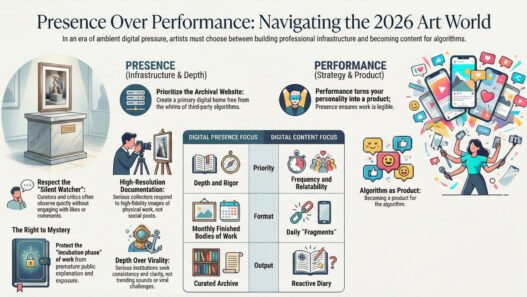
As we’ve discussed in our guides for artists, the most influential people in the art world (curators, museum directors, and legacy collectors) are Silent Watchers. They are not looking for hype; they are looking for Authority.
When you write a critical essay that challenges the artist’s narrative or places the work in a difficult historical context, you are signaling your own authority. You are showing that you have the “connoisseurship” to see beyond the sales pitch. This is how a writer builds a reputation that lasts longer than a single exhibition cycle.
The “New Criticism” Checklist for 2026
Before finalizing your next piece for Artinfoland, put your draft through this “Anti-Promotion” filter:
- Remove the “Hype” Adjectives: Can the sentence survive without the word “important” or “unique”?
- Add One External Connection: Does this text reference a historical movement, a scientific fact, or a current social shift?
- Identify a Conflict: What is the most “difficult” or “unresolved” part of this work?
- Verify Materiality: Have you described the physical or digital “matter” of the work in a way that someone who hasn’t seen it can feel?
Conclusion: Writing for the Long Game
The press release was designed to sell a show for a month. The critical essay is designed to preserve the show for a decade. By moving beyond promotional marketing, you are not just helping a gallery fill a room; you are contributing to the Cultural Archive.
In the decentralized, “Post-Digital” market of 2026, the most valuable thing a writer can offer is a sense of direction. When the noise of marketing fades, it is the voice of the critic (the one who dared to analyze rather than just applaud) that remains.