






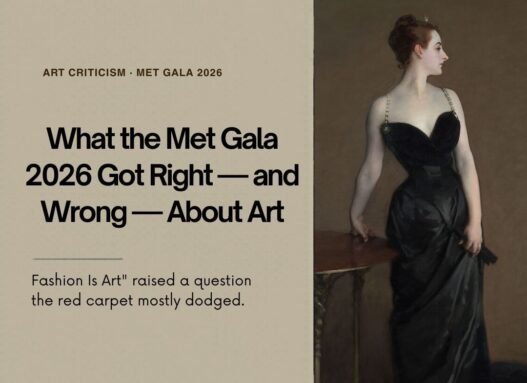
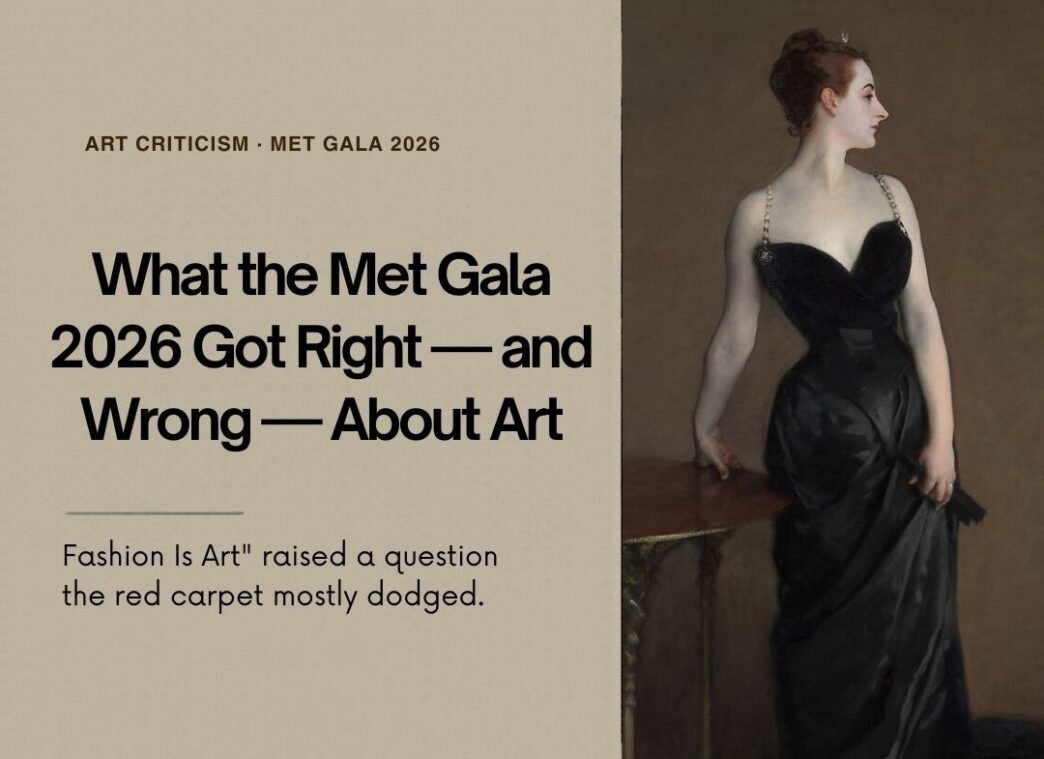
“Fashion Is Art” as a dress code raised a question the red carpet mostly dodged
The 2026 Met Gala arrived with a theme ambitious enough to make any art historian shift in their seat: *Fashion Is Art*. The corresponding Costume Institute exhibition, *Costume Art*, organised the history of dress around the body as a living canvas, treating garments as objects of artistic inquiry rather than mere documentation of taste. Pregnancy, aging, the classical ideal, the grotesque — all framed as formal problems, not social ones. On the steps of the Met on the evening of May 4, something rather different was happening.
What played out on that red carpet was not so much a dialogue between fashion and art as a very public test of a question the art world has been asking — and mostly avoiding answering honestly — for decades: what does it actually mean to *reference* a work of art, and when does reference become something shallower?
The answers, spread across roughly 150 looks, were mixed. A few were genuinely interesting. Many were not. And the gap between the two categories tells you something worth examining.
The References That Actually Held Up
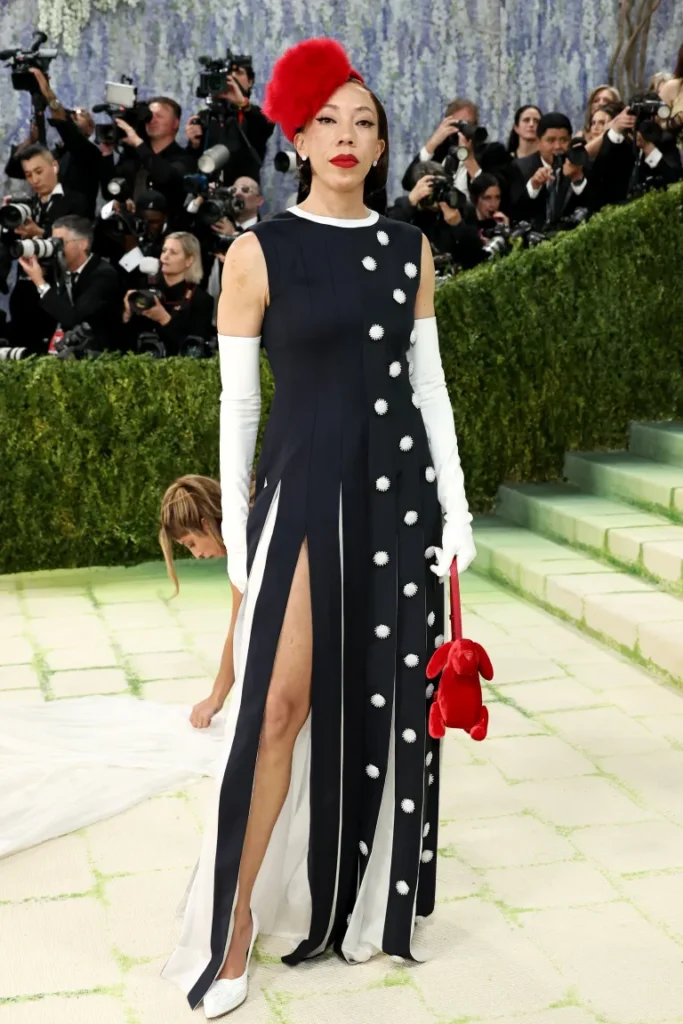
Amy Sherald, Miss Everything (Unsuppressed Deliverance), 2013. Courtesy the artist and Hauser & Wirth.
Amy Sherald arrived in a custom Thom Browne look modelled on her own 2013 painting *Miss Everything (Unsuppressed Deliverance)*: a black dress dotted on one side, white gloves, red fascinator. The look recreates the outfit worn by the painting’s sitter, a young woman named Crystal, whom Sherald photographed over an extended session until she relaxed into the pose. The work, which won the Outwin Boochever Portrait Competition in 2016 and remains the clearest single articulation of Sherald’s visual language, depicts a sitter whose identity is held in precise tension: grayed skin, deliberate stillness, garments that signal class and poise while the gaze refuses to confirm or deny anything. To wear the sitter’s outfit as your own costume — to embody a person you painted rather than wearing yourself — collapses the distance between artist, subject, and image in a way that is genuinely strange and genuinely interesting. It was the most self-aware thing anyone did all evening.
Hunter Schafer’s custom Prada look, drawn from Gustav Klimt’s *Mäda Primavesi* (1912–13), demonstrated something different: that close research produces better fashion.
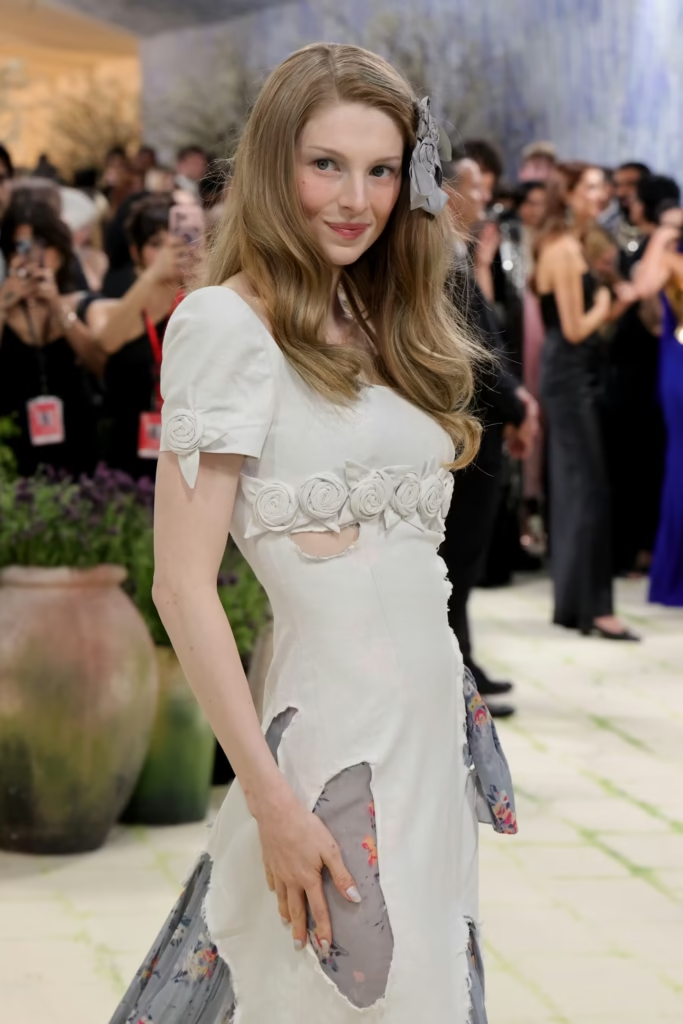
(Gustav Klimt, Mäda Primavesi, 1912–13. The Metropolitan Museum of Art, New York. Public domain.)
The painting — a portrait of nine-year-old Mäda, daughter of Otto and Eugenia Primavesi, two of the most important patrons of Austrian Symbolism — is in the Met’s own permanent collection. Schafer’s version kept the white ground, the floral appliqués, the oversized bow, the rosy-cheeked register of childhood formality. The cutouts and structural modifications that updated the silhouette for an adult body were considered rather than arbitrary. The reference was not decorative; it was load-bearing.
Madonna’s choice was the most pointed. Her Saint Laurent look, attended by seven costumed companions, referenced Leonora Carrington’s 1945 surrealist painting *The Temptation of St. Anthony. Fragment II*. The context is worth knowing: Carrington painted this work for the Bel Ami International Competition, in which Albert Lewin invited eleven surrealist and magic-realist painters to produce a canvas for use in his film *The Private Affairs of Bel Ami*. The jury included Alfred Barr, Marcel Duchamp, and Sidney Janis. Max Ernst won. The competition placed Carrington alongside Dalí, Paul Delvaux, and Dorothea Tanning, yet she remained for decades the artist most likely to be introduced as Ernst’s former companion rather than as the significant painter she was. Her market only broke the million-dollar barrier when she was in her nineties, and her work did not receive major institutional attention until the 2022 Venice Biennale titled its main exhibition after her book *The Milk of Dreams*. Madonna is a documented Carrington admirer, with the 1994 *Bedtime Story* video referencing another Carrington canvas. Whether the Saint Laurent execution matched the ambition of the reference is a separate question, but the choice itself was not accidental.
The References That Were Mostly Costumes
Winged Victory of Samothrace (Nike of Samothrace), c. 200–175 BCE. Louvre Museum, Paris. Public domain.
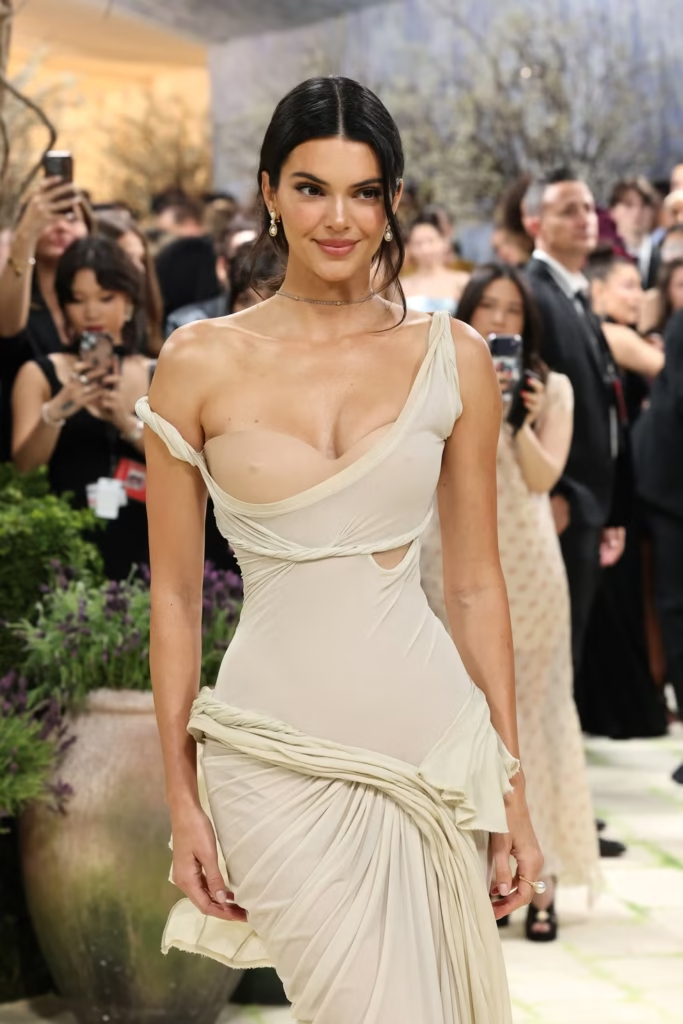
Kendall Jenner’s look, a gown in draped white fabric with the train suggesting a wing, was attributed to the Winged Victory of Samothrace. The attribution was not wrong. It was also not especially interesting. The Winged Victory is one of the most recognisable pieces of Hellenistic sculpture in the world, has been displayed at the top of the Louvre’s Daru staircase since 1884, and functions in visual culture less as a specific artwork and more as a synonym for *classical grandeur*. Using it as a silhouette reference is close to using the Eiffel Tower as a reference for Paris: technically accurate, analytically empty.
Three guests, Lauren Sánchez Bezos, Rosie Huntington-Whiteley, and Julianne Moore, arrived in looks attributed to Sargent’s *Madame X* (1884).
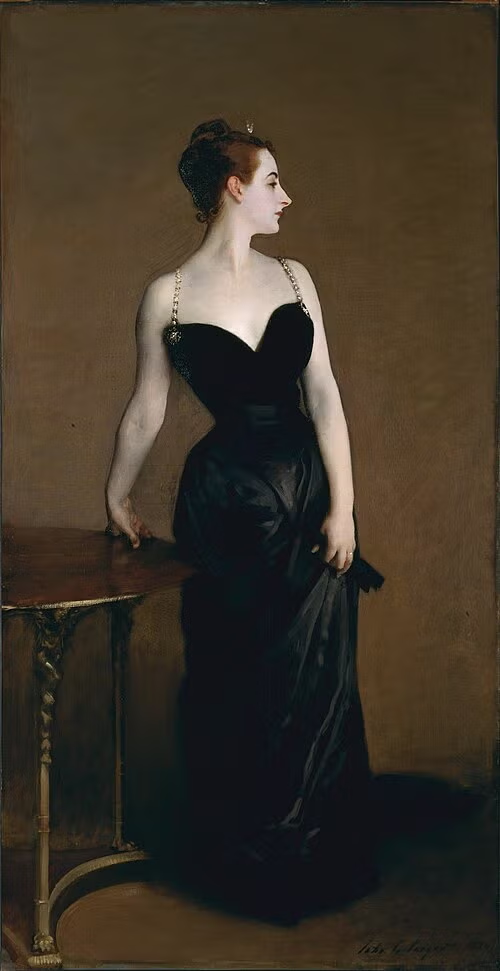
John Singer Sargent, Madame X (Madame Pierre Gautreau), 1883–84. The Metropolitan Museum of Art, New York. Public
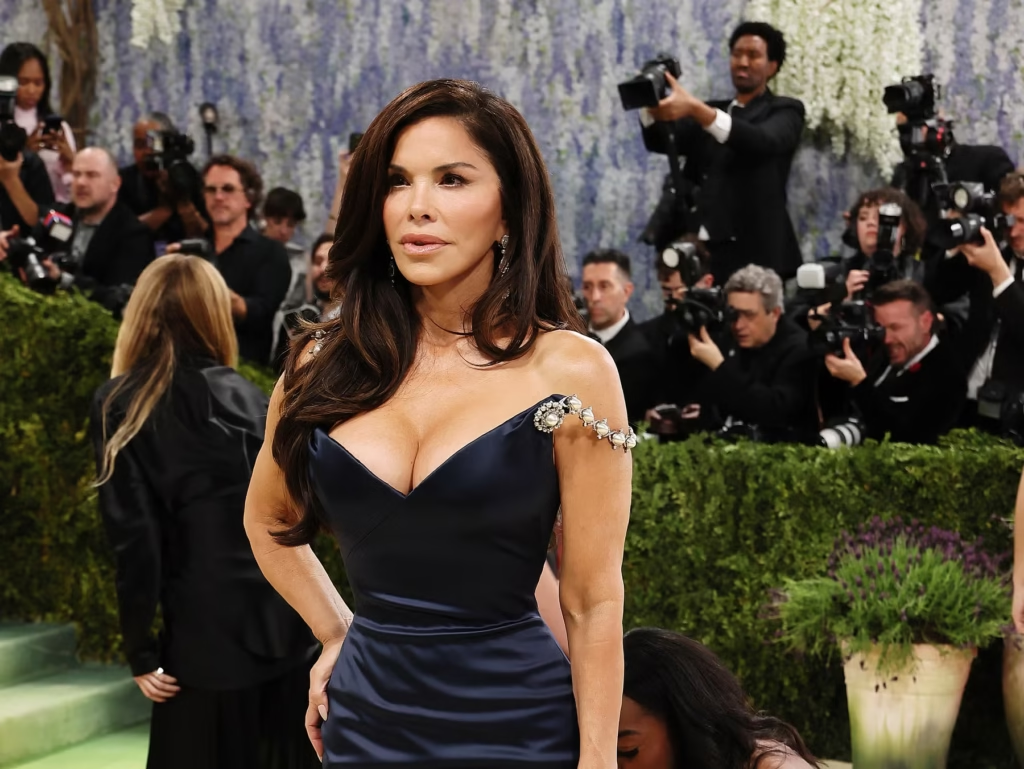
The portrait of Virginie Amélie Avegno Gautreau in a black evening gown with a jewelled strap was scandalous at its Salon debut; Sargent repainted the strap from off-shoulder to on-shoulder under social pressure. A single reference to that painting is an interesting choice. Three separate references to the same painting, on the same carpet, on the same evening, produces something more like a pattern: a signal that the most culturally legible works were the ones most reached for, and that cultural legibility and artistic engagement are not the same thing.
Heidi Klum’s reference to Giovanni Strazza’s *Veiled Virgin* and related veiled marble sculpture traditions was technically accomplished and visually striking, rendered in latex and foam to achieve the effect of translucent stone. It was also, in spirit, closer to Madame Tussauds than to contemporary art practice. The question the original works raise, what does it mean to suggest the vulnerability of a face through the materiality of carved stone, is not a question the foam costume seemed interested in asking.
What “Fashion Is Art” Actually Claims and What It Avoids
The claim *Fashion Is Art* has been asserted and contested for as long as fashion has had theorists. The version operative at the 2026 Met Gala seemed to mean something fairly specific and fairly limited: that garments can reference works of art, that garments can be made with the same level of craft and intentionality as artworks, and that therefore the people who commission, wear, and photograph them on high-profile stairs are participating in something culturally serious.
None of that is false. But it avoids the harder questions.
It avoids, for instance, the question of who benefits from art being associated with fashion. The Metropolitan Museum of Art’s Costume Institute raises a significant portion of its annual operating budget through the Gala. The cultural prestige conferred by art-world adjacency is part of what makes the event attractive to the fashion industry and its sponsors. The artists whose works appeared on the carpet, Klimt, Sargent, Carrington, Seurat, Matisse, are almost universally deceased, their works in the public domain or in institutional collections, their estates not consulted on the use of their imagery.
The one exception at this year’s Gala was Amy Sherald, who was both the artist and the one animating the reference. Her presence made visible something usually invisible: that in every other case, the artist was absent from the equation. The reference is extracted from the work, attached to the celebrity, and circulated without the artist’s participation, commentary, or compensation. This is not unique to the Met Gala. It is how popular visual culture has always processed fine art. But a theme called *Fashion Is Art* might be expected to notice it.
It also avoids the question of what it means to wear someone’s image. Two looks referenced Klimt’s portraits of specific women.
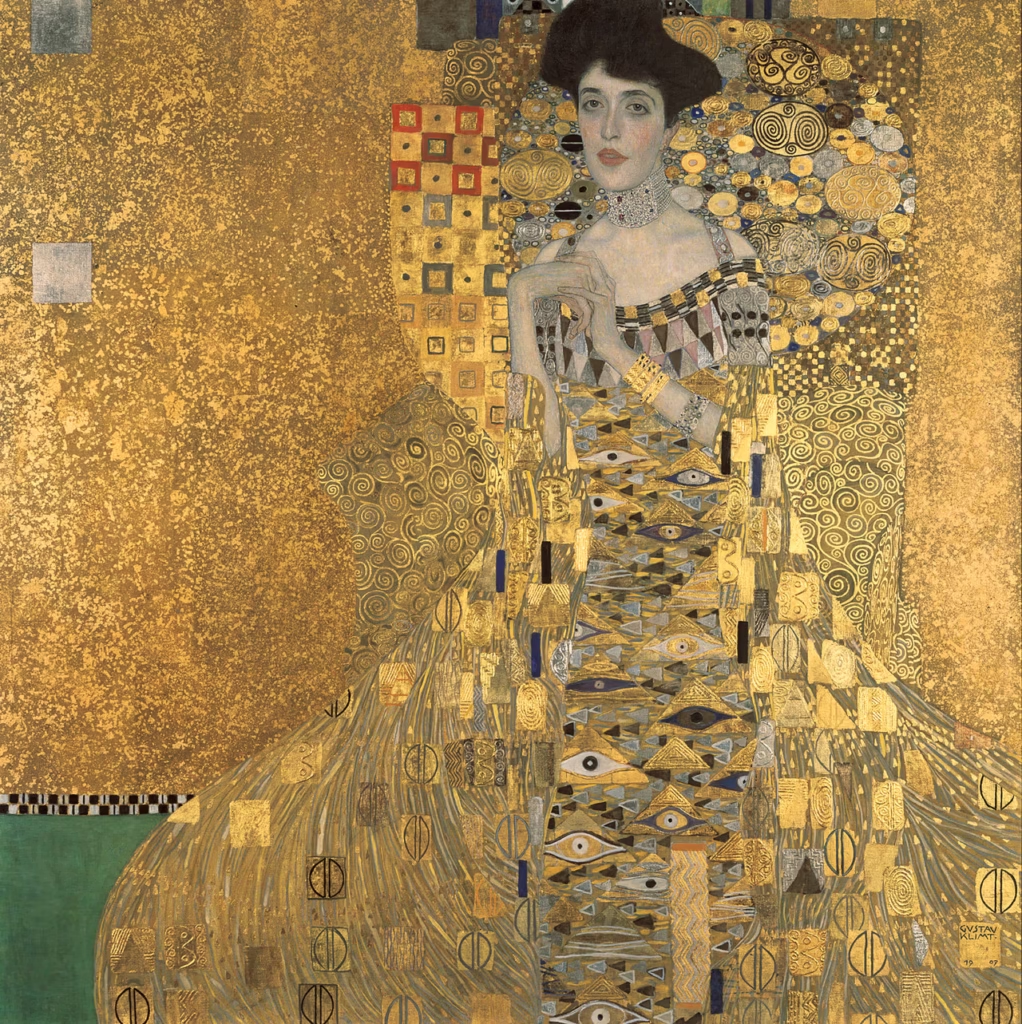
Gustav Klimt, Portrait of Adele Bloch-Bauer I, 1907. Neue Galerie, New York. Public domain.
Gracie Abrams’ gold Chanel look nodded to *Portrait of Adele Bloch-Bauer I* (1907), a painting whose history runs considerably darker than its gold surface suggests. The work was seized by the Nazis following Adele Bloch-Bauer’s death and her husband’s forced exile from Austria. It spent decades in the Österreichische Galerie Belvedere before a restitution case brought by the Bloch-Bauer family’s heir resulted in its return in 2006, after which it was sold to Ronald Lauder for $135 million. Decorating yourself as *Woman in Gold* on a red carpet flattens all of that into pure aesthetic. This is not a reason the look should not have been made. It is a reason the look should have known what it was referencing.
What the Carpet Got Right Anyway
The 2026 Gala was, by the standards of recent years, one of the more intellectually engaged red carpets the event has produced. This is a low bar, but it is not nothing.
Charli XCX’s Saint Laurent gown, silk, tulle, and resin with an iris flower motif, referenced Van Gogh’s *Irises* (1889) in a way that was less a reproduction than an adaptation: the flowers abstracted into material, the painting dissolved into textile. Anne Hathaway’s hand-painted Michael Kors ball gown, painted by artist Peter McGough, took Keats’ *Ode on a Grecian Urn* as its starting point and turned the wearer into a frieze figure, a living object from the collection she was about to enter. Naomi Watts’ Dior gown referenced the still life paintings of Dutch artist Rachel Ruysch (1664–1750), a notably less canonical choice, with hand-sculpted 3D flowers by nail artist Iram Shelton built out over five hours of work. Each of these was doing something more than shape-matching.
The references to non-Western art, Isha Ambani’s look drawing on Raja Ravi Varma’s *Padmini, the Lotus Lady*, Anok Yai’s Balenciaga gown inspired by *Mater Dolorosa*, represent a small widening of the usually Eurocentric vocabulary of art reference at these events. They are worth noting, though a single appearance on a carpet is not the same as a genuine interrogation of the canon.
Why This Matters for People Working in Art
The Met Gala has never claimed to be an art event, and it does not need to be. As a fundraiser and media spectacle, it operates on its own logic — and that logic runs on recognisability.
Not every look on the 2026 carpet can be examined here — and the ones that can are not offered as a complete verdict on the evening. But taken together, what they tend to share is a reliance on works already inside the canon: images familiar enough to travel without context, legible enough to read in a photograph. That is not a criticism of the individual choices. Some of them, as argued above, were genuinely engaged. But even the strongest references — Schafer’s Klimt, Madonna’s Carrington — drew from artists whose cultural weight was already established long before May 4.
The one exception was Amy Sherald, whose presence introduced a different kind of reference altogether: not a work absorbed into visual shorthand, but a painting still attached to its maker, its sitter, and its argument. What that difference reveals about how art circulates in high-visibility cultural spaces is probably worth more attention than any single look on the carpet.