





The 61st Venice Biennale, titled In Minor Keys, has quickly become one of the most controversial editions in the event’s 130-year history. Intended as a quiet meditation on fragility, caregiving, and overlooked voices, the exhibition has instead been overwhelmed by geopolitical conflict, institutional crisis, and public protest.
A Biennale Defined by Division
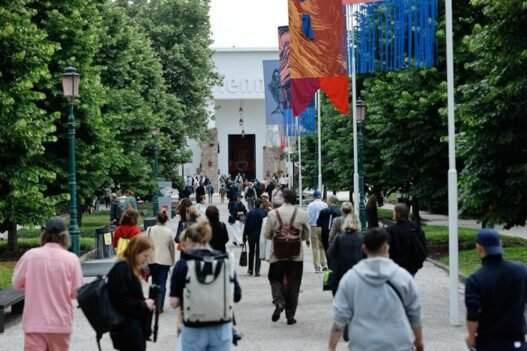
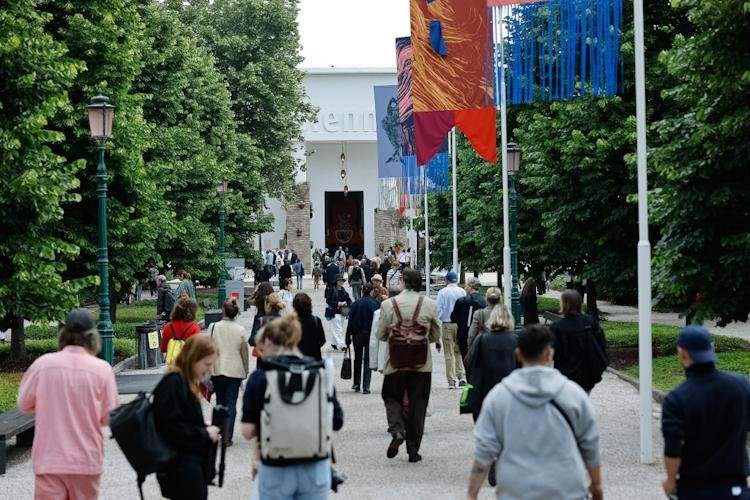
Curated by the late Cameroonian curator Koyo Kouoh — the first African woman to helm the Biennale — In Minor Keys opened on May 9, 2026, under unusually heavy clouds. Kouoh’s passing in 2025 added emotional weight to the project, which her team completed in her spirit: emphasizing subtlety, listening, and “minor” frequencies over spectacle. Yet the reality on the ground has been anything but quiet.
At the heart of the storm are two national pavilions: Russia and Israel.
Russia’s participation marked its return since the full-scale invasion of Ukraine in 2022. The pavilion, titled The Tree is Rooted in the Sky, remained closed to the general public during the opening days, accessible only to press. This decision satisfied almost no one. European Union officials threatened funding cuts, while many in the art community viewed the inclusion itself as a moral failure.
The Israel pavilion faced even fiercer opposition. Over 200 prominent artists, curators, and cultural workers — including Turner Prize winner Lubaina Himid and Alfredo Jaar — signed an open letter demanding its exclusion over the ongoing war in Gaza. Protests erupted almost daily, with activist groups including Pussy Riot and FEMEN staging dramatic interventions, some spilling over to the Russian pavilion.
The Historic Jury Resignation
The most shocking moment came just days before the opening. The entire five-member international jury — all women — resigned en masse on April 30, 2026.
In their statement, the jurors declared they could not in good conscience award prizes to artists representing countries whose leaders face International Criminal Court (ICC) arrest warrants for crimes against humanity. The move directly targeted Russia and Israel. Organizers pushed back, citing the Biennale’s tradition of artistic neutrality and national representation. When the jury stood firm, they stepped down completely.
As a result, no official Golden Lion awards were granted for the first time in modern Biennale history. Instead, organizers introduced a public “people’s choice” vote — a makeshift solution that many viewed as damage control rather than a principled stand.
Withdrawals, Protests, and a Crisis of Neutrality
The fallout was swift. Nearly half the artists in the main exhibition withdrew from award consideration in solidarity with the jury. On-site actions included silent processions, activist performances, and heated confrontations with security.
The controversies have exposed a deeper structural tension: Can an event built on national pavilions — a model created in the 19th century — remain relevant and ethically defensible in today’s fractured world? Critics argue the Biennale’s claim to political neutrality is no longer tenable. Defenders warn that excluding nations sets a dangerous precedent that could silence artistic dialogue entirely.
Themes vs. Reality
The irony is painful. Kouoh’s vision focused on tenderness, vulnerability, and caregiving in difficult times. Yet the dominant narrative has been one of loud global conflict. Many visitors and critics have noted the disconnect between the gentle, introspective works inside the Arsenale and Giardini and the protests raging outside.
Additional tensions involving the U.S. pavilion (linked to domestic political shifts) and smaller disputes with other participating countries have only added to the sense of an institution under strain.
What It Means for the Future
The 61st Venice Biennale may be remembered less for its artworks and more as a turning point — a moment when global crises finally fractured the art world’s ability to maintain diplomatic distance. It has forced uncomfortable questions about the responsibilities of major cultural institutions during active conflicts.
For some, this chaos represents progress: proof that art cannot and should not ignore reality. For others, it signals a troubling politicization that risks undermining the Biennale’s role as a space for genuine cultural exchange.
As the exhibition runs through November 22, 2026, one thing is certain: Venice 2026 has shattered the illusion of neutrality. In doing so, it has become a mirror — however uncomfortable — of our fractured age.