




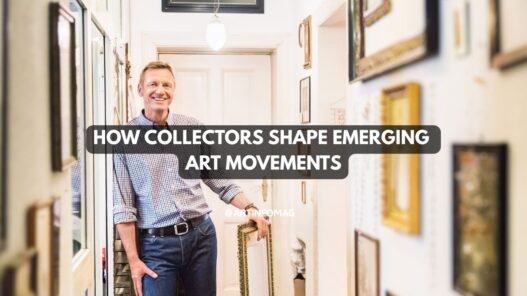
Private collectors have always done more than buy art. They have funded movements, defined canons, created institutions, and — sometimes — bent the development of entire artistic generations toward their own preferences. This article examines how that power actually works, what it means for artists, and what the history of collecting teaches about the relationship between money and artistic freedom.
The story of modern art is usually told through artists. The movements, the manifestos, the formal breakthroughs, the critical reversals — these are narrated as the achievements of individuals and groups working through ideas. This is not wrong, but it is incomplete. Running alongside the story of artistic development is another story, less often told: the story of who paid for it, who collected it first, whose taste shaped what was possible to make and show and sell. The collector is not a passive figure in art history. They are one of its primary agents.
This is not a cynical observation. It is a structural one. Emerging art movements require resources — studio space, materials, exhibition opportunities, critical attention — and those resources have to come from somewhere. In the absence of significant public funding, they come disproportionately from private collectors: individuals whose wealth, taste, and institutional connections determine which artists get the conditions to develop, which movements get the visibility to become canonical, and which practices remain marginal regardless of their quality.
Understanding this dynamic is not a counsel of cynicism about art or collecting. It is a prerequisite for navigating both honestly. Artists who understand how collector relationships actually shape careers — and where those relationships risk distorting practice — are better positioned to make conscious decisions about the ones they enter. Collectors who understand their own role in art history are better positioned to use it thoughtfully.
The collector does not merely respond to art history. In the early stages of an emerging movement, the collector is one of the forces that determines which version of that history gets written.
The Mechanisms of Collector Influence
Collector influence on emerging movements operates through several distinct mechanisms, not all of them obvious. Understanding them separately makes it possible to think clearly about how each one functions — and where each one introduces risks as well as benefits.
Mechanism 01 — Early Financial Validation
The first purchase changes everything
When a serious collector acquires work from an emerging artist, the act is not merely financial. It is a signal — to galleries, to institutions, to other collectors, and to the artist themselves — that this practice is worth sustained attention. The early collector creates a market where none existed, and that market creation has consequences that extend far beyond the transaction itself. It changes what the artist can negotiate with galleries, what residency programmes will consider, what critics will review. The first significant sale is often the pivot point around which an early career turns.
Mechanism 02 — Network Access
Collectors carry artists into rooms they could not otherwise enter
Serious collectors exist at the intersection of the art world’s institutional, commercial, and social networks. When they champion an artist, they introduce that artist to curators who trust their judgment, to other collectors who follow their taste, to foundation boards that fund the programmes the artist wants access to. This network effect is one of the most powerful and least visible mechanisms of collector influence. An artist with a significant collector advocate is not merely wealthier — they are structurally repositioned within the art world’s information and opportunity flows.
Mechanism 03 — Institutional Donation
The collection gift that writes the canon
When collectors donate or lend works to public institutions, they make decisions about what gets preserved, studied, and taught to future generations. The private collections that become museum gifts — the Saatchi collection’s influence on British institutional holdings, the Vogel collection’s transformation of American minimalism’s institutional presence, the Di Rosa Foundation’s documentation of Bay Area figurative work — are direct interventions in art history. The collector who decides which artists belong together in a collection is, in the long run, making an argument about the shape of a movement that the institution will then amplify across decades.
Mechanism 04 — Taste Formation
What collectors buy shapes what gets made
In the early stages of an emerging movement, the work that collectors actively purchase influences what artists continue to make. This is not always a crude transaction — most artists are not consciously tailoring their work to collector demand — but the feedback loop is real. Work that sells is work that sustains a practice; work that does not sell is work that requires other sources of support to continue. Over time, if the collectors active in a particular emerging scene consistently prefer certain formal qualities, certain scales, certain subjects, those preferences shape the development of the movement — not through explicit instruction but through the simple economics of what it is possible to keep making.
Mechanism 05 — Publication and Critical Infrastructure
Collectors fund the language through which movements are understood
Catalogues, monographs, critical essays, and documentary films require funding. In many cases, particularly at the early stages of a movement, that funding comes from collectors who are invested in seeing the work contextualised and historicised. The collector who funds the first monograph on an artist is not merely being generous — they are shaping the critical framework through which all subsequent engagement with the artist’s work will be mediated. The language introduced in collector-funded publications often becomes the dominant language for understanding a movement for decades.
Mechanism 06 — Speculation and Distortion
The mechanism that can damage as well as support
Not all collector influence is beneficial to the movements it touches. When speculative collectors acquire work primarily for financial return — driving prices beyond what the underlying practice can sustain, creating artificial scarcity, or promoting certain artists within a movement while ignoring others whose work is equally significant — they can distort the development of the movement itself. Rapid price escalation around a small number of artists in an emerging scene can crowd out the slower, deeper engagement with the broader field that produces genuine art historical significance. The bubble around a movement is often driven not by broad collector engagement with its ideas but by a small number of speculative buyers treating it as an asset class.
Historical Examples: When Collector Vision Shaped a Movement
The historical record of collector influence on emerging movements is extensive and instructive. A few examples illuminate how the dynamic works in practice — and what its consequences, both positive and problematic, have looked like across different periods.
Historical Case 01
Gertrude Stein and Early Modernism in Paris
Gertrude Stein and her brother Leo began collecting Cézanne, Matisse, and Picasso at a moment when none of these artists had significant institutional recognition. Their apartment at 27 rue de Fleurus functioned simultaneously as a private collection, a salon, and an informal critical institution — a space where artists, writers, and intellectuals encountered work that was not yet legible to most contemporary audiences. Stein’s sustained financial and intellectual investment in Picasso across decades of his early development was not merely philanthropic. It created the conditions in which Cubism could develop to the point of institutional legibility. The collection preceded and in important respects shaped the critical discourse that later became the dominant account of early modernism.
Historical Case 02
The Vogels and American Minimalism
Herbert and Dorothy Vogel were a postal worker and a librarian who, over fifty years, amassed one of the most significant collections of American minimalist and conceptual art ever assembled — using modest incomes, buying directly from artists, storing works in their Manhattan apartment, and following aesthetic conviction rather than market logic. Their collection of nearly five thousand works, donated to the National Gallery and subsequently distributed to fifty state institutions, directly shaped the institutional holdings that now define how American art of the 1960s and 1970s is taught and understood. Their model — deep engagement with a specific moment, sustained over decades, uncoupled from financial speculation — demonstrates what collector influence looks like when it operates at its best.
Historical Case 03
The YBA Moment and the Saatchi Effect
Charles Saatchi’s systematic acquisition of work by young British artists in the late 1980s and early 1990s — and his use of his private gallery space to exhibit them — is one of the most studied examples of collector influence on an emerging movement. Saatchi’s advocacy was decisive in creating the international visibility of Damien Hirst, Tracey Emin, and their peers. It was also, from relatively early, contested: the concentration of collecting power in a single figure, the alignment of the movement’s public identity with a specific collector’s preferences, and the question of what happened to artists when Saatchi sold their work — sometimes depressing prices just as the artists were establishing their market positions — were all identified as structural problems. The YBA story is a case study in both the enabling and the distorting potential of concentrated collector influence.
What Collectors Actually Look for in Emerging Work
Understanding what motivates serious collectors when they engage with emerging art is useful for artists partly because it explains the dynamics of early collecting relationships — and partly because it reveals where those motivations can produce relationships that are genuinely productive for both parties, and where they can produce relationships that subtly distort the practice they are supporting.
The motivations of collectors are not uniform. They range across a spectrum from genuinely disinterested aesthetic engagement to explicitly financial speculation, with most serious collectors occupying a complex position that combines several motivations simultaneously and does not always remain in the same place across time.
Aesthetic conviction
The collector who buys because the work genuinely moves them, challenges them, or answers a question they have been carrying. This motivation produces the most useful and least distorting relationships for artists — the collector is responding to the work itself, not to a position in a market or a social network. The collecting histories that most consistently produce significant outcomes for both artists and art history are driven by this kind of motivation.
Cultural positioning
The collector who acquires art partly as a form of social and cultural capital — demonstrating taste, gaining access to art world networks, building a public identity as a cultural patron. This motivation is not inherently problematic, but it introduces pressures that can affect the artist-collector relationship. Collectors motivated significantly by cultural positioning tend to be sensitive to critical consensus and market trends, which can make their support less reliable in periods when an artist’s work is developing in directions that are not yet critically or commercially validated.
Financial investment
The collector who acquires primarily or substantially for financial return. This motivation is the most transparent and, in its pure form, the least useful for artists at early stages of their careers. The financial investor has a defined time horizon and exit strategy; the artist’s development rarely maps cleanly onto either. The mixing of financial and aesthetic motivations — which is extremely common — creates a complex dynamic in which the collector’s continued engagement with an artist’s practice depends partly on factors that have nothing to do with the quality or direction of the work.
Intellectual engagement
The collector who is genuinely interested in the ideas the work is engaging with — who reads the criticism, attends the lectures, has opinions about the discourse the artist is working within. This motivation produces the most intellectually rich collecting relationships and, often, the most useful ones for the artists involved. The collector who understands what an artist is doing at the level of ideas is the one best positioned to introduce them to the curators, critics, and institutions whose engagement would be most valuable.
Practical Example: How One Collector Relationship Develops
The following scenario traces a fictional but composite relationship between an emerging painter and a private collector over seven years. It illustrates both the generative potential of early collector relationships and the points at which they require conscious navigation.
Scenario — Seven Years, One Collector Relationship
Year 1. A painter is included in a group exhibition at a small commercial gallery. A collector attends the opening and is genuinely struck by two of the works. They purchase one — a modest price, a direct studio-to-wall transaction — and ask if they can visit the studio. The studio visit goes well. The collector is knowledgeable, asks good questions, and is clearly responding to the ideas in the work rather than its market position. They purchase two more works.
Years 2–3. The collector introduces the painter to a curator they know whose research closely connects to what the artist is working on. The introduction leads to the painter being included in a significant group exhibition. The collector lends one of their works to the exhibition. They continue to acquire work from each new body of work, visit the studio annually, and occasionally recommend the artist to colleagues.
Year 4. The painter begins a new body of work that is a significant departure from the previous direction — more formally austere, less immediately visually engaging, responding to a set of questions that have been developing slowly over two years. The collector visits the studio, sees the new work, and is quietly less enthusiastic. They do not say this directly, but they do not acquire anything from the new series. They mention, more than once, how much they loved the earlier paintings.
Year 5. This is the critical moment. The painter is aware of the collector’s preference for the earlier work. They are also aware that the new direction is the most interesting thing they have done — that it is solving a problem they have been living with for years. The temptation to return to the earlier work, or to modulate the new direction toward something the collector would find more accessible, is real and felt. The painter continues with the new work.
Years 6–7. The new body of work receives a solo exhibition at a mid-size institution. A different collector — introduced by the curator from Year 2, now a close professional contact — acquires three works. Critical response is the strongest the painter has received. The original collector, attending the opening, tells the painter the work has grown into something they hadn’t initially understood. They acquire one work from the new series. The relationship continues — on slightly different terms, with the painter’s autonomy more firmly established within it.
The Year 4-5 period in this scenario is where the dynamics of collector influence become most practically significant for artists. The collector’s preference for earlier work is not coercive — it is a market signal, a social signal, and a relationship dynamic, all at once. The artist who bends to it does not do so because they are told to. They do so because the relationship has value, because the financial support matters, and because human beings naturally incline toward the approval of people whose judgment they respect. The autonomy required to continue in a new direction under these conditions is a skill that has to be developed, not assumed.
The Risks for Artists — and How to Navigate Them
Early collector relationships carry real risks for artists, and naming them clearly is more useful than the alternative — the politely euphemistic conversation about “managing collector relationships” that art school graduates sometimes receive in lieu of an honest account of the pressures involved.
Risk 01 — The Preference Trap
The collector who loved your early work becomes, over time, an implicit argument for not changing. This is rarely explicit — collectors who genuinely care about an artist’s development rarely demand stylistic continuity — but the financial and relational weight of their existing preference creates a gravitational pull toward the work they already understand. Artists who recognise this pull and make conscious decisions about when to follow it and when to resist it are significantly better positioned than those who experience it as an ambient pressure without a source.
Risk 02 — Concentration Dependency
When a single collector accounts for a significant proportion of an artist’s income and institutional access, the relationship that should be generative becomes one that cannot be allowed to fail. The artist who cannot afford to lose a specific collector’s support is the artist whose practice is partially governed by that collector’s continued approval. Diversification of collecting relationships — like diversification of income streams more generally — is a structural protection for artistic autonomy.
Risk 03 — The Secondary Market Problem
When collectors who acquired work early sell it — particularly through auction, and particularly in large quantities — the price signals can damage an artist’s market at precisely the moment when it is trying to establish itself at a higher level. The Saatchi effect, described above, is the most famous instance of this. Artists cannot control the secondary market behaviour of their collectors, but they can — through careful attention to who buys early work and at what price — make choices that reduce the probability of damaging secondary market activity.
Risk 04 — Identity Capture
When a specific collector becomes publicly identified as the primary champion of an artist’s work, the artist’s identity in the art world becomes partially bound to that collector’s reputation and taste. If the collector’s reputation later declines — due to financial scandal, shifting critical assessment of their collection, or changes in their own public standing — the artist’s public identity can be negatively affected even if the work itself is unimpeachable. This is a subtle but real risk, particularly for artists at early stages of their careers when their independent critical identity has not yet been firmly established.
What Artists Can Do — Practical Positions
The following are not rules. They are positions — ways of orienting toward collector relationships that protect artistic autonomy while remaining genuinely open to the support that serious collectors can offer.
01 Know why a collector is buying
Not by asking them directly, but by paying attention to how they talk about the work, what they say about the context of their collection, whether they are responding to the ideas or the market signal. A collector who can describe what your work is doing beyond its visual appearance is a collector whose enthusiasm is likely to survive you doing something different.
02 Diversify early and deliberately
Even when a single collector’s support feels sufficient, work actively to develop relationships with multiple collectors across different geographies, institutional affiliations, and collecting motivations. The practice that depends on one collector’s continued approval has built a structural vulnerability into its financial foundation.
03 Be clear about what is not for sale
Not the work — the direction of the practice. Artists who are clear with themselves, and eventually with their collecting relationships, about the fact that the work will go where it needs to go regardless of market preference are artists who can accept collector support without ceding the autonomy that makes the work worth supporting in the first place.
04 Understand the secondary market implications of early sales
Who buys your work early, at what prices, and with what collecting intentions matters for your secondary market position later. This is not an argument for being selective to the point of commercial paralysis — early-career artists need income and cannot always be choosy. It is an argument for being aware that early sales have downstream consequences and for establishing relationships with collectors who have a history of holding rather than flipping.
05 Recognise the relationship as reciprocal
The collector who engages seriously with your work is not doing you a favour. They are participating in something that matters to them — aesthetically, intellectually, or personally. Understanding the relationship as genuinely mutual, rather than as dependency in either direction, is what makes it possible to navigate its pressures honestly and to build the kind of sustained professional relationship that serves both parties across the long arc of a career.
The most generative collector relationships in art history are not those in which the collector funded what the artist already knew how to make. They are those in which the support created the conditions for the artist to develop in directions they could not have reached without it — and then got out of the way.
Find Residencies, Grants & Open Calls to Build Your Practice
ArtInfoLand lists opportunities across 85+ countries — independent of market dynamics, curated for artists who are building practices with long-term depth. Find the programmes right for where your work is going.