





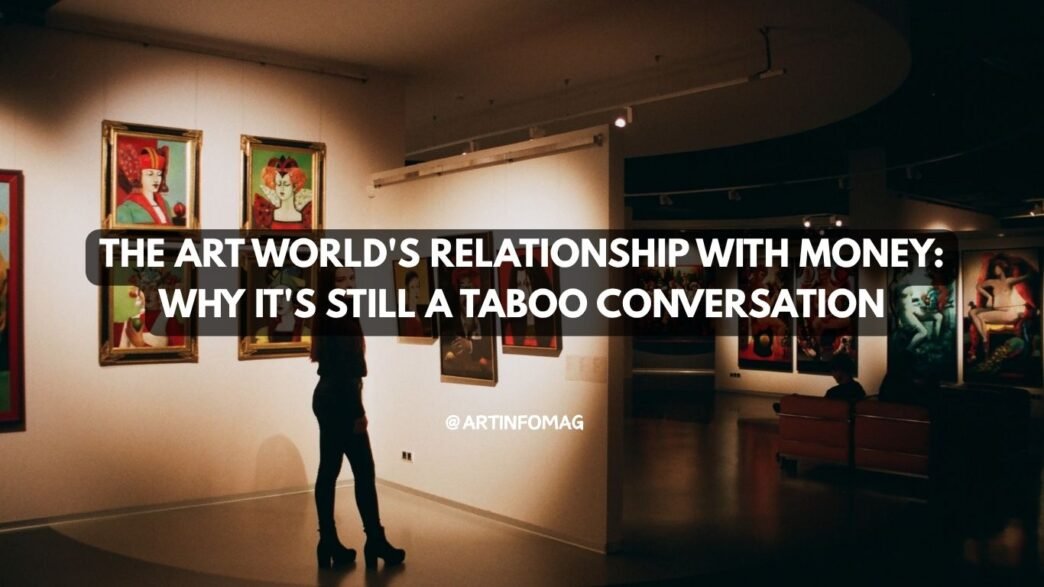
The market moves billions. Yet asking what anything costs — or what anyone earns — remains one of the most transgressive acts you can commit at a vernissage.
There is a peculiar ritual that happens at gallery openings. People stand in front of price lists — those discreet sheets folded near the front desk, or sometimes not displayed at all — and pretend not to be reading them. They glance. They calculate. They move on, expression carefully neutral. To ask out loud what a work costs is to mark yourself as someone who doesn’t quite understand the space. And to understand the space is, among other things, to know that you don’t ask.
This silence is not accidental. It has been cultivated over centuries, and it serves a purpose. The art world is one of the last places where the fiction that beauty and commerce occupy entirely separate realms is still maintained with a straight face — even as Christie’s posts eight-figure results the morning after, even as art funds advertise double-digit returns, even as the word “investment” is whispered at every fair worth attending.
The contradiction is not lost on anyone inside the system. It is, in fact, the system.
A History of Deliberate Obscurity
The mystification of art’s economic dimensions has deep roots. When the church and then aristocratic patronage gave way to the open market in the eighteenth and nineteenth centuries, new legitimizing myths had to be invented. The Romantic notion of the artist as a figure above commerce — tortured, solitary, motivated by inner necessity rather than external reward — was not simply a cultural affectation. It was a market mechanism. A work made by someone who wasn’t thinking about money was, paradoxically, worth more money.
This logic has never quite left us. We still tend to regard artists who speak openly about income, rates, and financial survival as somehow less serious than those who perform indifference to such concerns. The artist who negotiates her fee is admired privately and judged publicly. The artist who says “I can’t afford to participate without an honorarium” is considered difficult, or commercial, or both.
The art world doesn’t refuse to discuss money because money is unimportant. It refuses because transparency would expose the profound inequalities on which the entire structure rests.— ArtInfoLand
Collectors understand this dynamic and exploit it fluently. Galleries understand it and use it to maintain asymmetries of information that keep prices opaque, resale rights murky, and the logic of valuation safely mystical. Institutions understand it and use it to continue extracting labor from artists — through unpaid proposals, speculative commissions, low-fee residencies, and the currency of “exposure” — without ever having to account for the exchange.
· · ·
What Transparency Would Reveal
Consider what a genuinely transparent art world would look like. Gallery commissions — typically between 40 and 60 percent — would be publicly disclosed, allowing artists to make informed decisions about representation. Institutional acquisition budgets would be visible, making it harder to offer token fees to living artists while spending freely on secondary market purchases. Honoraria for exhibitions, catalogue essays, and public programs would be standardized and published, eliminating the negotiation theater that currently disadvantages artists without powerful advocates.
Artist fees paid at major biennials would be comparable across institutions, removing the practice — still common — of asking artists to cover production costs from a nominal fee while the institution gains the reputational value of their work. Studio rents, material costs, the economics of maintaining a practice across a decade: all of this would enter the conversation, making visible what it actually takes to be an artist rather than preserving the myth that passion is its own compensation.
The reason none of this has happened is not inertia. It is interest. The opacity serves those at the top of the hierarchy and disadvantages those at the bottom. It is a feature, not a failure.
The Artist’s Complicity — and Its Limits
It would be easy — and unfair — to place all responsibility on institutions and the market. Artists themselves have historically participated in the suppression of economic candor, often out of genuine belief in the separateness of art from commerce, but also out of survival calculation. To speak about money is to risk being seen as mercenary in a world where the appearance of disinterest is part of what makes you interesting.
This is changing, slowly, and the change is generational. Younger artists, many of them carrying significant debt and working in cities where studio rents have tripled in a decade, are less willing to perform the romance of poverty. Online communities and artist advocacy organizations have pushed conversations about fair pay, transparent fee structures, and collective bargaining into spaces where they were previously unthinkable. The W.A.G.E. (Working Artists and the Greater Economy) initiative, which certifies institutions that pay minimum fees to artists, has done more to shift the conversation than a decade of panel discussions.
W.A.G.E. certification standards suggest a minimum of $500 for a short-term solo exhibition. Industry surveys consistently show that a majority of artists earn below the poverty line from their practice alone, regardless of critical recognition. These numbers rarely appear in the same publication that reviews their work.
Social media has played an ambivalent role. On one hand, it has created platforms where artists can speak directly about their economic conditions — naming what they were offered, declining publicly, comparing notes. On the other hand, the same platforms reward the aestheticization of the studio, the curated glimpse of making, the performance of creative freedom — all of which reproduce the fantasy that the artist exists outside the cash economy.
The Collector Silence
If artist economics are rarely discussed, collector economics are almost never discussed. The art market operates in near-total opacity when it comes to who is buying, at what price, and for what purpose. This is partly legal — auction houses and galleries are not required to disclose buyers — and partly cultural. The collector who speaks openly about the financial mechanics of their collection is regarded with mild suspicion: if they’re talking about money, are they really in it for the art?
Yet the financial structures of collecting are far from neutral. Donations of artworks to museums generate tax deductions at appraised values that may exceed what the donor actually paid. Resale at auction generates capital gains — or, through careful estate planning, avoids tax entirely. Art loans to institutions maintain the fiction of public access while the work appreciates privately. These are not marginal practices; they are how significant portions of the art world’s economy function, and they have direct consequences for what gets shown, valued, and preserved.
The question is not whether money shapes the art world. It is whether we are willing to look clearly at how — and at whose expense.— ArtInfoLand
Openness here would complicate comfortable narratives about philanthropy and the public good. It would require us to ask whether museum wings named after billionaires represent genuine generosity or sophisticated asset management. It would require us to examine the relationship between collecting and speculation, between taste and portfolio management, between love of art and the very specific ways that love is structured by tax codes and inheritance laws.
Internationalism as a Mirror
The taboo around money in the art world is not universal. It is, in large part, a Western — and particularly an Anglo-American — affliction, rooted in class anxieties specific to those cultures. In other contexts, the economics of art are discussed with considerably less shame. In many Middle Eastern markets, asking what something costs is not a social error but a normal part of engagement. In several East Asian contexts, the collector’s economic status and the work’s investment potential are openly integrated into the discourse around it.
This is not to say those contexts are free of their own distortions — they have different ones. But the contrast reveals that the particular silence maintained in the Western art world is a cultural choice, not a universal law. It could be otherwise. And in an increasingly internationalized market, where buyers, artists, and institutions interact across dramatically different cultural norms, the pretense is becoming harder to sustain.
The Conversation We Need
None of this is an argument that art should be reduced to its economic dimensions. The experience of standing before a work that reorganizes your perception, the encounter with an object that somehow holds more time than time — these are real, and they are not the same thing as its price.
But the refusal to discuss money is not the same as protecting art from commerce. It is, most often, a way of protecting certain arrangements of power from scrutiny. The gallerist who won’t publish a price list is not preserving the mystique of art; they are preserving their own leverage. The institution that pays artists in prestige rather than currency is not elevating the work; it is subsidizing its program on the backs of the people who make it possible.
A more honest art world would not be a less beautiful one. It would be one in which the conditions that allow beauty to be produced — studios, time, health insurance, the ability to take risks without destitution — are regarded as seriously as the beauty itself. It would be one in which the artist who says “I need to be paid fairly” is understood to be making an argument about the value of art, not undermining it.
That conversation is overdue. And it begins, simply, with deciding that asking is not a transgression.