







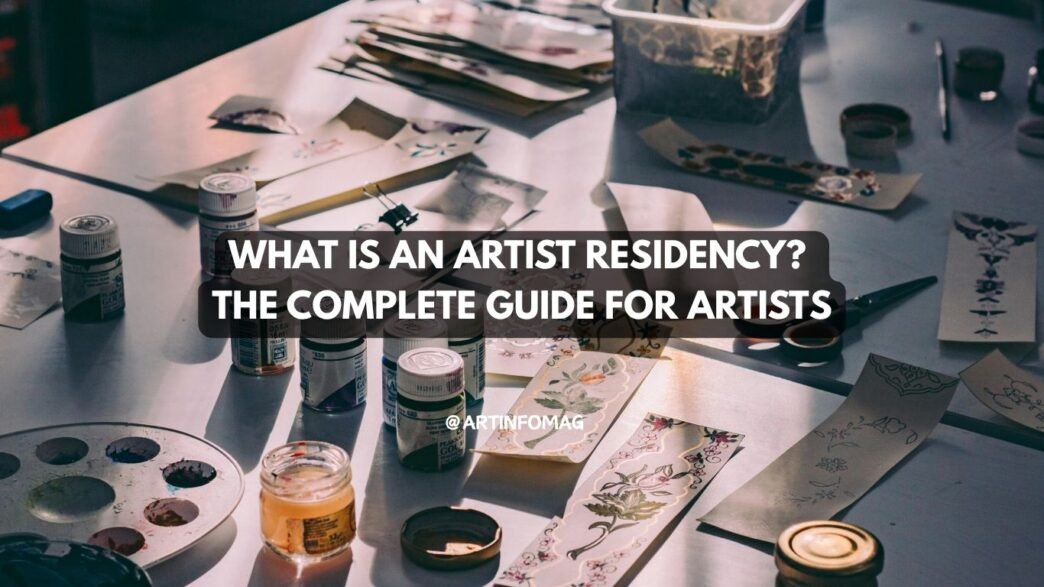
Residencies give artists something ordinary life rarely allows: uninterrupted time, a dedicated space to work, and a community that takes the work seriously. Here is how they function, who they are for, what they cost, and how to land one.
An artist residency is a program that invites an artist to live and work at a host site for a defined period — providing studio space, focused time, and often accommodation, funding, and a community of peers. Residencies exist across every discipline, from painting, sculpture, and photography to writing, music, film, choreography, and interdisciplinary research.
At its heart, a residency is an exchange. The host — a foundation, museum, university, artist-run space, or even a rural retreat — offers the conditions to make work. In return, the artist brings their practice into the space, contributes to its cultural life, and often shares the outcome through a talk, an open studio, or an exhibition. Some residencies are quiet and solitary; others are intensely social. Some hand you a key and leave you alone for two months; others expect daily engagement with a theme, a place, or a community.
What unites them all is the gift of removal — the chance to step out of the routines that fragment a creative life and give sustained attention to the work itself.
On this page
- How residencies
- Types of residencies
- What’s usually included
- Who they’re for
- How long they last
- Why do a residency
- Costs and funding
- How to find them
- How to apply
- Tips to get accepted
- Well-known examples
- Before you accept
- FAQ
How does an artist residency work?
The mechanics vary, but most residencies follow a recognizable shape. A host organization opens a call for applications, sometimes year-round and sometimes once or twice a year. Artists apply with a portfolio, a project proposal, and supporting documents. A panel or curator reviews the submissions and selects the residents.
Once accepted, you travel to the host site for your allotted period. On arrival you’re usually given a studio or workspace and, in most live-in programs, a place to sleep. From there, the structure loosens or tightens depending on the program. A production residency might give you technicians and a workshop to realize an ambitious piece. A research residency might expect reading, fieldwork, and conversation rather than finished objects. A retreat-style residency might ask almost nothing of you except that you show up and work.
Many residencies close with a public outcome: an open studio, an artist talk, a screening, a reading, or a group exhibition. This isn’t universal, but it’s common enough that you should assume some form of sharing is expected and check the details before you apply.
Types of artist residencies
“Residency” is an umbrella term covering programs with very different aims and economics. It helps to sort them along three axes: who pays, what the focus is, and how they’re structured.
By funding model
- Fully funded residencies. The host covers accommodation and studio space and often adds a stipend, travel costs, and a materials or production budget. These are the most competitive.
- Partially funded residencies. Some costs are covered — perhaps free studio and lodging — while the artist pays for travel, food, or materials.
- Fee-based residencies. The artist pays for the stay. These can still be valuable, especially in expensive cities or specialized facilities, and the fee is sometimes offset by external grants or scholarships.
- Self-directed or unfunded residencies. The host provides space and context but no money, leaving the artist to fund the stay independently.
By focus and discipline
- Production residencies centered on making a specific body of work, often with specialist equipment (print studios, ceramics kilns, foundries, editing suites).
- Research residencies that prioritize investigation, archives, and experimentation over finished output.
- Thematic residencies organized around a subject — ecology, migration, technology, a particular archive or place.
- Discipline-specific residencies for writers, composers, filmmakers, dancers, curators, or craftspeople.
- Socially engaged and community residencies that embed the artist in a school, hospital, neighborhood, or institution.
- Rural and remote retreats that trade facilities for solitude, landscape, and distance from the art market.
By structure
- Live-in residencies, where you sleep and work on site.
- Non-residential (“studio only”) residencies, where you’re given a workspace but arrange your own housing — common in the city you already live in.
- Group residencies, where a cohort of artists overlaps and forms a temporary community.
- Solo residencies, where you may be the only artist on site.
- Virtual or online residencies, a newer format offering mentorship, structure, and community without relocation.
What’s usually included in a residency
No two offers are identical, so the terms matter enormously. Depending on the program, a residency package may include some or all of the following:
- A private or shared studio or workspace
- Accommodation on or near the site
- A stipend to cover living costs or lost income
- A materials or production budget
- Travel to and from the residency
- Access to specialist equipment, workshops, or technicians
- Mentorship, studio visits, or critique sessions
- A final exhibition, publication, or public event
- Introductions to the local art scene, curators, and institutions
Because “residency” can mean anything from an all-expenses-paid three months to a paid-for desk in a shared studio, read the offer line by line and calculate your real costs before committing.
Who are artist residencies for?
Residencies serve artists at every stage and in nearly every discipline. Some programs specifically support emerging artists, recent graduates, or those without gallery representation. Others are aimed at mid-career and established practitioners with a substantial body of work. A growing number focus on particular communities — women artists, Indigenous artists, artists from a specific region or diaspora, disabled artists, or artists working on a defined social theme.
Eligibility is where applicants most often waste effort. A residency for early-career painters is not looking for a mid-career filmmaker, however strong the work. Reading the criteria carefully and applying only where you genuinely fit is the single most efficient thing you can do.
How long do artist residencies last?
Duration ranges enormously. A few programs offer intensive stays of just a few days; the most common length sits somewhere between two weeks and three months; and a small number of prestigious programs run for six months to a full year. The right length depends on three things: the scale of your project, how long you can realistically step away from home and work, and whether the program is funded enough to make a long stay sustainable.
Why do an artist residency? The benefits
Residencies aren’t only about producing objects. Artists return again and again for reasons that reach well beyond the studio:
- Concentrated time. The rarest resource in a creative life is uninterrupted attention. A residency protects it.
- Space and facilities you might never afford or access otherwise.
- Community and peers. Overlapping with other artists produces conversations, collaborations, and friendships that outlast the residency itself.
- New context. A different landscape, culture, or set of materials can push a practice in directions it would never have found at home.
- Professional profile. A competitive residency is a meaningful line on a CV and a signal of recognition to curators, funders, and galleries.
- Networks. Introductions to local institutions, curators, and collectors can open doors long after you leave.
- Momentum. Many artists credit a residency with unblocking a project or marking a turning point in their work.
Find your next residency on ArtInfoLand
ArtInfoLand tracks verified, up-to-date artist residencies across 85+ countries — funded and fee-based, for every discipline and career stage. Browse open calls, filter by what matters to you, and apply with confidence. Browse artist residencies →
How much does an artist residency cost?
This is the question that separates a life-changing opportunity from a financial trap, and the honest answer is: it depends entirely on the program.
A fully funded residency can cost you almost nothing and may even pay you — covering housing, studio, travel, and adding a stipend. A fee-based residency can run from a few hundred to several thousand dollars for the stay, on top of your own travel and living expenses. Between those extremes sits a wide middle ground where lodging or studio is free but you cover the rest.
When you calculate the true cost, don’t stop at the advertised fee. Add travel, shipping of materials or work, insurance, visa costs for international residencies, and — crucially — the income you’ll forgo while you’re away. Then weigh that against grants and scholarships you might secure to offset it. Many artists fund a fee-based or unfunded residency with a project grant, a crowdfunding campaign, or support from a foundation in their home country. Fully funded Housing, studio, often travel and a stipend covered. Most competitive. Partially funded Some costs covered; you pay the rest (often travel and materials). Fee-based You pay for the stay. Can be offset with external grants. Hidden costs to budget for Travel, shipping, insurance, visas, and lost income while away.
How to find artist residencies
Opportunities are scattered across institutional websites, mailing lists, social media, and open-call databases, which makes a reliable, curated source invaluable. To search effectively:
- Use a dedicated opportunities platform that verifies listings and lets you filter by discipline, funding, country, and deadline.
- Follow the residencies and institutions whose values and past residents resemble your own practice.
- Sign up for newsletters and open-call alerts so deadlines don’t pass you by.
- Ask peers who have done residencies — word of mouth surfaces programs that never advertise widely.
- Keep a running shortlist with deadlines, since strong applications take weeks to prepare.
ArtInfoLand exists precisely to solve this problem: verified international residencies, grants, and open calls gathered in one place, so you spend your time making work and writing strong applications rather than hunting for opportunities.
How to apply for an artist residency
Applications differ, but most ask for a familiar set of materials. Prepare these well and you can adapt them for many calls:
- A portfolio of your strongest recent work, presented exactly to the required specifications (image count, file format, resolution).
- An artist statement — a concise account of what your work is about and why you make it.
- A project proposal describing what you intend to do during the residency and why this host, in this place, is the right context for it.
- A CV listing exhibitions, education, and relevant experience.
- A cover letter or letter of motivation, where requested.
- References or letters of recommendation for some programs.
- Work samples in the right medium — writing samples, audio, or video links for non-visual disciplines.
Note application deadlines and fees early. Some residencies charge a small, non-refundable application fee; factor that into how many you apply to.
How to get accepted: tips that actually help
- Apply where you truly fit. A tailored application to the right program beats twenty generic ones. Selectors can tell instantly when a proposal was written for someone else’s call.
- Connect your project to the host. Show that you understand the residency’s mission, its location, and what it offers, and explain why your project needs precisely those conditions.
- Lead with your strongest work. A portfolio is judged on its best and its weakest pieces — cut anything that doesn’t earn its place.
- Be specific and concrete. Vague ambitions (“explore themes of memory”) lose to clear intentions (“produce a series of six large-format cyanotypes using water from the region”).
- Follow the guidelines exactly. Wrong file formats, over-length statements, or missing documents get applications rejected before they’re read.
- Give yourself time. The strongest applications are drafted, set aside, and revised — not written the night before the deadline.
- Keep going. Rejection is normal, even for excellent artists. Competitive programs turn away most applicants; persistence is part of the process.
Well-known artist residencies
A handful of long-established programs give a sense of the range. These are illustrative, not a ranking — the best residency for you is the one that fits your practice, not the most famous name.
- MacDowell (New Hampshire, USA) and Yaddo (Saratoga Springs, USA) — historic retreats supporting artists and writers across disciplines.
- Skowhegan School of Painting & Sculpture (Maine, USA) — an intensive summer program for emerging artists.
- Rijksakademie (Amsterdam, Netherlands) — a prestigious two-year residency with studios and advisors.
- Cité internationale des arts (Paris, France) — hundreds of studios hosting international artists.
- Villa Medici / French Academy in Rome (Italy) — a storied program for artists and scholars.
- International Studio & Curatorial Program (ISCP) (New York, USA) — studios for international visual artists and curators.
- Delfina Foundation (London, UK) — thematic residencies with a strong public program.
- Bemis Center for Contemporary Arts (Omaha, USA) — funded residencies with a stipend and large studios.
Beyond these, thousands of residencies operate worldwide — in cities and villages, deserts and forests, universities and factories — many of them far less known but perfectly suited to a particular artist and project.
Before you accept: questions to ask
Once you’re offered a place, treat the decision as seriously as the application. Ask the host — or check the terms — for the answers to these:
- Exactly what is covered, and what will I pay for out of pocket?
- Is there a stipend, and is it enough to live on in this location?
- What studio and equipment will I actually have access to?
- What is expected of me — public events, teaching, donated work, a finished piece?
- Who owns or exhibits the work I make during the residency?
- What are the living conditions — private or shared, remote or central, accessible?
- For international stays: what visa do I need, and who arranges it?
A residency that’s wrong for your circumstances can cost more than it gives. A little diligence up front protects both your finances and your practice.
Frequently asked questions
What is an artist residency in simple terms?
It’s an arrangement where an organization gives an artist time, space, and often money to focus on their work for a set period, usually away from their normal life. In exchange, the artist brings their practice into the host’s community and often shares the results.
Do artist residencies pay you?
Some do and some don’t. Fully funded residencies cover housing and studio costs and may add a stipend, travel, and a materials budget. Fee-based residencies ask the artist to pay. Always read the terms before applying.
Do you need to be a professional artist to apply?
Not necessarily. Many residencies welcome emerging artists, students, and career changers, while others target mid-career or established practitioners. Check each program’s eligibility criteria carefully.
How competitive are artist residencies?
The most prestigious, fully funded programs are highly competitive and turn away the majority of applicants. Less well-known and fee-based residencies are often far easier to enter. Applying to programs that genuinely fit your work improves your odds considerably.
Can you do an artist residency online?
Yes. Virtual residencies are a growing format, offering mentorship, structure, deadlines, and community without the need to relocate — useful for artists who can’t travel or step away from home.
What’s the difference between a residency and a grant?
A grant is money awarded to support your work, which you use however the terms allow. A residency provides time, space, and context — and may or may not include funding. Some residencies are effectively grants with a place attached; others offer only the space.
Ready to find the right residency?
Explore verified artist residencies and open calls from around the world on ArtInfoLand — filtered by discipline, funding, and deadline, and checked so you don’t apply into the void.