







LONDON — Twenty-eight years after hosting his first major UK survey, London’s iconic Hayward Gallery is once again surrendering its Brutalist architecture to the mind-bending, viscera-stained universe of Sir Anish Kapoor.
Serving as the crown jewel of the Southbank Centre’s 75th-anniversary program, this highly anticipated blockbuster retrospective—simply titled Anish Kapoor—runs from June 16 to October 18, 2026. Curated by Ralph Rugoff, the exhibition tracks four decades of the Turner Prize-winning artist’s career while heavily foregrounding highly ambitious new commissions. The result is a theatrical, divine bloodbath that shifts seamlessly between the cosmic sublime and aggressive, physical abjection.
1. Suffocation and Sacrifice: The Ground Floor
Visitors entering the exhibition are immediately denied the breathing room typical of a major gallery space. The six-meter-high ground floor is completely swallowed by All of Nothing (2026), a massive, bulbous, inflated red PVC membrane. The structure forces visitors to awkwardly skirt the perimeter of the room, instantly destabilizing their sense of scale and self.
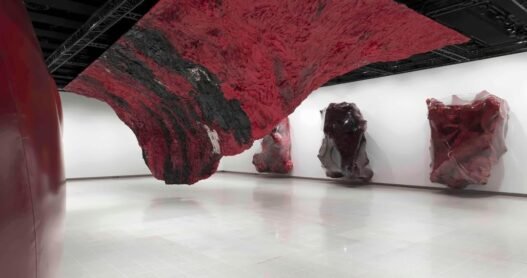
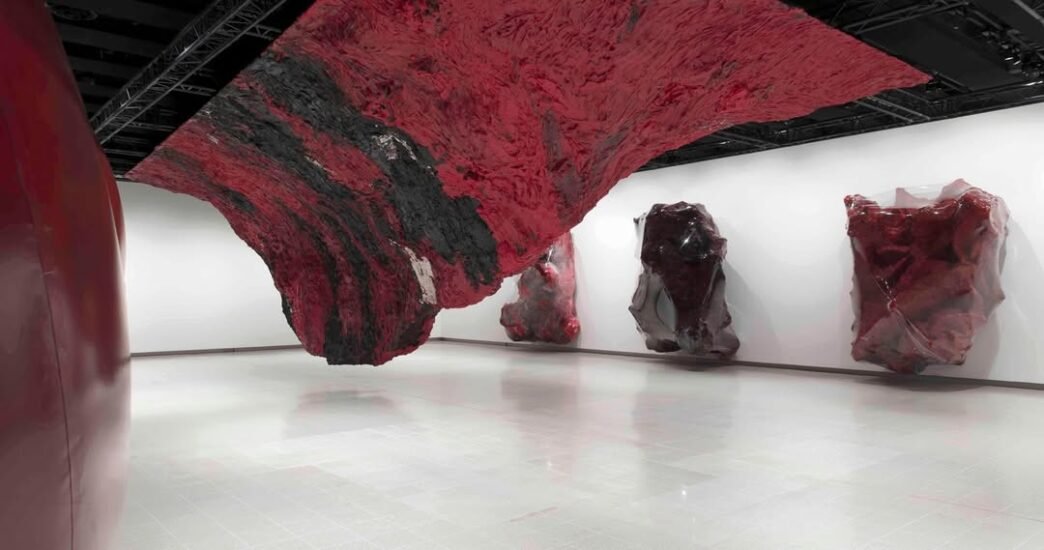
Moving deeper, the initial spatial disorientation takes a dark, bodily turn. The centerpiece of the lower level is a trio of works titled Plastic Sacrifice I, II, III (2026). Part painting, part three-dimensional sculpture, these pieces feature crimson and purple silicone entrails that appear to slop off the walls. Wrapped in a tight, transparent, surgical-looking synthetic skin, they resemble violently contained biological matter—or, as some critics have noted, a macabre echo of Rembrandt’s Slaughtered Ox.
Nearby, the gravity-defying Mount Moriah at the Gate of the Ghetto (2022) looms from above. A massive, inverted mountain slathered in layers of dark red and black pigment, the sculpture hovers just inches above the floor tiles, threatening to crush the viewer under its spiritual and physical weight.
2. Into the Abyss: Vantablack and Ha Makom
Upstairs, the exhibition transitions from the physical body to the immaterial spirit, relying heavily on Kapoor’s ongoing obsession with the “void.”
| Materials of the Void | Physical Manifestations |
| 🔹 Vantablack Nanotechnology: Absorbs more than 99% of light | 🩸 Dark Crimson Pigments: Creating a sense of gravity and visceral depth |
| 🔹 Complete Loss of Depth: Eliminates the viewer’s spatial perception | 🩸 Slathered Silicone & Resin: Forming organic, fleshy, and raw textures |
| 🔹 Illusion of Flatness: Turning 3D voids into flat, two-dimensional planes | 🩸 Inflated PVC Membranes: Swallowing architectural spaces entirely |
| 🔹 Portals into Nothingness: Creating an unsettling gaze into a black hole | 🩸 Formless, Oozing Trays: Displaying matter in a state of decay or collapse |
A dedicated gallery highlights Kapoor’s use of Vantablack—a nanotechnology material that absorbs more than 99% of light. When applied to three-dimensional structures, it entirely eliminates depth perception, turning gaping holes and physical objects into flat, bottomless abysses. Audiences are left staring into a series of optical illusions, unsure if they are looking at a flat canvas or a portal into nothingness.
This thematic confrontation culminates in Ha Makom (2026), a Hebrew title translating to “The Place.” A sprawling, jagged landscape constructed of dark, rocky material, the installation slowly ascends toward a pitch-black doorway at its peak. It serves as an ultimate synthesis of Kapoor’s career: a monument to the unknown, where material presence dissolves entirely into the immaterial.
3. The Skyline Reflected
For visitors overwhelmed by the gore and existential dread of the indoor galleries, the Hayward’s outdoor terraces offer a brief, familiar reprieve. Here, Rugoff has installed Kapoor’s signature large-scale mirrored stainless steel sculptures.
Interacting directly with the shifting London summer skyline, these highly polished forms—including one that warps space like a giant, reflective crisp—twist and fracture the surrounding architecture. They flip the city upside down, providing a playful, disorienting counterweight to the dark, introspective journey inside.
“I am deeply interested in the body being the central thematic of sculpture—of art, perhaps. Scale is important for the physical reaction it incites in the viewer.”
— Anish Kapoor
Anish Kapoor is a definitive, uncompromising look at a master artist operating at the height of his powers. By forcing us to confront religion, mortality, and the raw mechanics of our own flesh, the Hayward Gallery has staged an unmissable, beautifully unsettling exhibition that will undoubtedly dominate the cultural conversation for the rest of the year.
To watch the exhibition spaces come alive and hear the artist reflect on his return to London, check out this Anish Kapoor Hayward Gallery Exhibition Tour, which captures the scale and intense coloration of the monumental installations.