






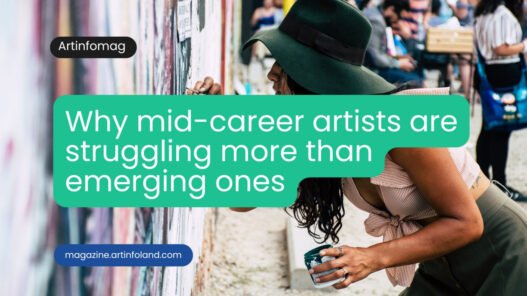
In the traditional narrative of a career, time and experience are supposed to equal stability. In medicine, law, or academia, fifteen years of practice grants you seniority. But in the contemporary art world, the middle of the ladder has become the most precarious place to stand.
While “Emerging Artists” benefit from the industry’s obsession with discovery and “Established” legends sit securely in museum permanent collections, the mid-career artist is often left navigating a systemic void. As ArtInfoLand enters 2025, the “Mid-Career Crisis” is no longer a personal psychological phase; it is a structural economic reality.
1. The “Novelty Bias” of the Art Market
The contemporary art market is obsessed with the “New.” Collectors and curators are often hunting for the next big thing, the “ultra-contemporary” 24-year-old with a fresh MFA and a skyrocketing price point. 
-
For Emerging Artists: There is a sense of discovery and “potential profit” that attracts speculative collectors.
-
For Mid-Career Artists: The “newness” has worn off. You have a track record, which is great for your CV, but it removes the mystery that drives market hype. You are no longer a “discovery,” but you aren’t yet a “blue-chip master.”
2. The Institutional Funding Gap
Most grants, residencies, and awards are strictly age-gated or career-stage gated.
-
The “Under 35” Trap: There is a wealth of support for artists just starting out. However, once you hit 40 or have been practicing for 15 years, those “emerging artist” grants disappear.
-
The Missing Middle: There are very few “Mid-Career Support” grants. Institutions often assume that if you’ve had a few museum shows, you must be financially stable. In reality, the costs of maintaining a larger studio and more complex productions often grow faster than the artist’s actual income.
3. Price Point Stagnation
This is the “financial ceiling” many mid-career artists hit. To get to mid-career status, you’ve likely raised your prices steadily.
-
The Dead Zone: You might find yourself in a price bracket (say, $10,000–$25,000) that is too expensive for casual “impulse” buyers but not high enough to attract the high-stakes investors who only buy “trophy” art.
-
The Overhead Crush: Mid-career work is often more ambitious, requiring more expensive materials, assistants, and specialized storage. If sales don’t keep pace with these growing overhead costs, the artist is actually making less profit than they were when they were “emerging” and working from a kitchen table.
4. The “Gallery Squeeze”
The middle-tier galleries—the ones that traditionally nurture mid-career artists, are closing at an alarming rate.
-
The Polarization: The art world is splitting into “Mega-Galleries” (who only want you once you’re a superstar) and “Project Spaces” (who only want the newest kids).
-
The Loss of Advocacy: When a mid-career artist loses their gallery, it is much harder to find a new one. Dealers are often hesitant to “take on” someone else’s mid-career artist because they feel the primary market growth has already happened.
5. The Emotional Toll of the “Long Game”
Being an emerging artist is fueled by adrenaline and the hope of the “big break.” By mid-career, that adrenaline has faded into the reality of a long-distance marathon.
-
Burnout: After 20 years of shipping work, writing statements, and navigating the social politics of the art world without a “permanent” safety net, many artists face a profound sense of fatigue.
-
The Pivot: Mid-career artists are often expected to “stay in their lane” so they don’t confuse their collectors. This can lead to a feeling of being creatively trapped, whereas an emerging artist is allowed (and expected) to experiment wildly.
The Silver Lining: How to Survive the Middle
If you are in this stage, the goal shifts from visibility to sustainability. * Focus on Legacy, Not Hype: Mid-career is the time to focus on institutional acquisitions (museums) and high-quality publications rather than Instagram trends.
-
Diversify the Practice: Many successful mid-career artists survive by moving into “research-based” projects, teaching, or consulting, using their decades of expertise as a secondary product.
-
Own Your Audience: This is the time to double down on your Newsletter and personal collector relationships. You don’t need a gallery to advocate for you if you have 20 loyal patrons who have followed you for two decades.
The “Middle” is where the most profound art is often made, because it’s backed by a lifetime of experience. The challenge is surviving the system long enough to become “Established.”







I noticed this too. Glad to see someone writing about it. With that I feel there can be less opportunities too for upskilling and connecting with other artists.