




Talent is the entry fee. What sustains a practice over a decade — over a life — is something far less glamorous, and far more within your control.
The art world has a mythology problem. It is in love with the idea of talent — raw, inexplicable, arriving fully formed in certain people and absent in others. This mythology is compelling, partly because it is occasionally true, and largely because it is comforting. If success belongs to the talented, then the rest of us are off the hook. We need not show up every day. We need not risk failure in public, over and over, across years. We simply wait to discover whether we are among the chosen.
But spend time with the actual biographies of artists who have built lasting practices — not the sanitized retrospective versions, but the real chronologies of rejection, reinvention, and stubborn return — and a different picture emerges. Talent, in almost every case, was the beginning of the story, not its engine. What drove the work forward, year after year, was consistency: the unglamorous, underphotographed practice of showing up to the studio, the page, the camera, the instrument — even when nothing was working, even when the market wasn’t looking, even when the artist themselves had lost faith in what they were making.
This is not an argument against talent. It is an argument for understanding what talent actually is, and what it requires to become anything.
· · ·
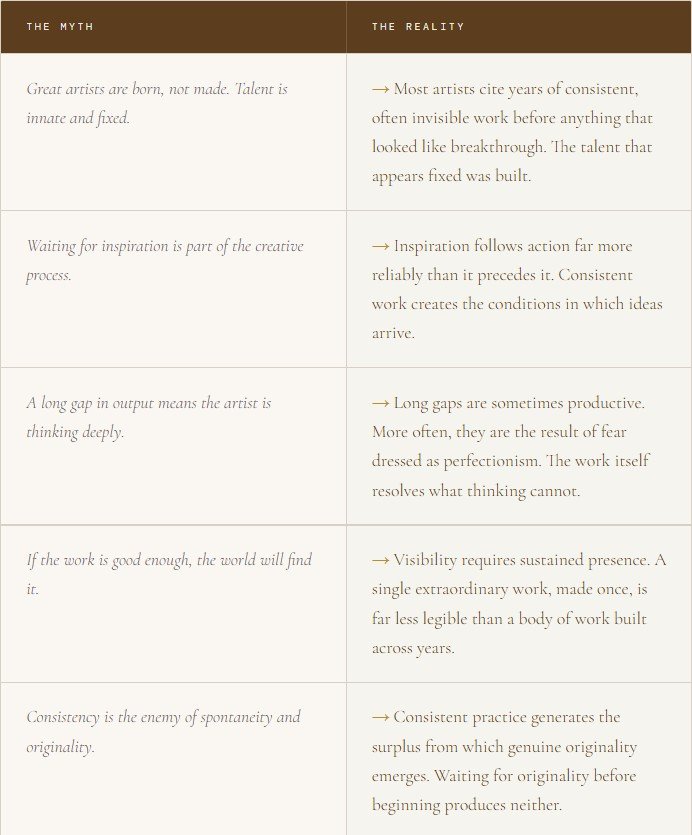
The Myths We Tell About How Art Gets Made
Before examining what consistency actually does in an artistic practice, it’s worth naming the myths that stand in its way — because they are not merely romantic abstractions. They shape decisions: whether to apply for a residency, whether to keep working through a dry period, whether to regard a slow year as failure or as gestation.
What Consistency Actually Does
The case for consistency is not motivational — it is structural. Consistent practice does specific, identifiable things to an artistic practice that no amount of talent, waiting, or occasional brilliance can replicate.
First, it builds a body of work. This sounds obvious and is frequently underestimated. A body of work is not simply a quantity of objects or images; it is the accumulation of decisions, experiments, failures, and returns that gives a practice its legibility to others. Curators, collectors, writers, and institutions do not respond to single works in isolation — they respond to evidence of sustained inquiry, to the sense that an artist is pursuing something over time and that each work is a chapter in a longer argument. That legibility cannot be manufactured retrospectively. It accrues, slowly, through the ordinary discipline of continuing.
Second, consistent practice develops skill in ways that intermittent effort cannot. This is well-documented in domains far beyond art — the neuroscience of learning consistently shows that spaced, repeated engagement with a skill builds neural pathways more effectively than intense bursts followed by long absences. For artists, this means that the painter who works in the studio three hours every weekday will, over five years, have access to a technical fluency that the painter who works intensively for three weeks twice a year will not. The talent may be equivalent. The skill will not be.
The artists who last are not always the most gifted people in the room. They are the people who returned to the room, for years, after everyone else had left.
– ArtInfoLand
Third — and perhaps most importantly — consistency builds tolerance for failure. Every artist who works regularly produces work that doesn’t succeed. This is not a bug; it is the mechanism through which the work that does succeed becomes possible. The artist who works rarely treats each piece as a high-stakes event, investing it with so much pressure that the risk of failure becomes reason not to begin. The artist who works consistently has enough volume that any individual failure is simply part of the process — information, not verdict.
Artists Who Stayed in the Room
History is full of artists whose legacies look, in retrospect, like sudden emergence — as if the work arrived fully formed from some mysterious source. The actual chronologies tell a different story.
Louise Bourgeois
Worked for 40 years before major recognition;
Bourgeois was 71 when her first major retrospective opened at MoMA in 1982. She had been making work continuously since the 1940s — sculptures, drawings, installations — largely without the institutional attention that came to define her legacy. The Spider series that made her globally known came when she was in her eighties. Four decades of consistent practice preceded it.
Cézanne
Refused to stop through decades of rejection;
Cézanne was rejected from the École des Beaux-Arts, dismissed by critics, and excluded from the official Salon repeatedly. He continued working in near-isolation in Aix-en-Provence for years. The paintings that would influence every major art movement of the twentieth century were made in sustained, quiet, unfashionable consistency. Recognition arrived late and largely posthumously.
Agnes Martin
Rebuilt her practice from silence;
Martin abandoned painting entirely in 1967 at the height of her recognition, moved to New Mexico, and lived without making art for several years. When she returned to painting in the early 1970s, she rebuilt a practice from the beginning — grids, pale washes, meditative repetition — and continued it, consistently, until her death at 92. The late work is inseparable from the sustained practice that produced it.
Kara Walker
Built recognition through relentless output;
Walker’s silhouette installations brought immediate and controversial attention when they appeared in the mid-1990s. What is less often noted is the volume of work that accompanied and followed that recognition — drawings, prints, films, sculptures, public works — produced at a pace that kept her practice legible and evolving across three decades. The recognition was sparked by talent; it was sustained by consistency.
The Consistency That Isn’t What It Looks Like
There is an important clarification to make here, because “consistency” is sometimes misread as uniformity — as if the prescription is to make the same work, in the same way, every day, indefinitely. That is not what sustained practice looks like in practice, and conflating the two is a source of unnecessary anxiety for many artists.
Consistency is about sustained engagement with your practice — returning to the studio, the notebook, the computer, the camera, the conversation — not about producing identical work or maintaining a fixed style. The artist who spends three months making drawings that go nowhere before finding a direction that opens everything up has been consistent. The artist who spends three months doing nothing because they don’t know what comes next has not.
A Useful Distinction
Consistency is not the same as productivity. You can be consistent and produce little visible output — if the work of those sessions is thinking, looking, failing, and revising. What consistency opposes is absence: the months that pass without returning to the practice at all, usually dressed as waiting, or research, or needing more time to think. Those absences compound. The return from them becomes harder each time.
Nor is consistency the opposite of rest. Deliberate breaks — genuine pauses for recovery, reflection, travel, living — are part of a sustainable practice. The distinction is between a rest that you choose and return from, and a drift that happens to you and from which the return becomes increasingly distant. One is part of consistency. The other is its interruption.
Five Principles for Building a Consistent Practice
01 Set a minimum, not a maximum
The goal of a consistent practice is not to work as much as possible. It is to establish a minimum below which you do not fall. One hour in the studio on the hardest day is worth far more than ten hours on the best day if the hard days are where the practice lives or dies. Define the floor and protect it.
02 Decouple output from quality judgment
Judgment has a place in an artistic practice — but it is not the place of daily production. The session in which you make something and immediately evaluate its worthiness is a session in which you will produce less, risk less, and discover less. Work first. Evaluate later, from a distance.
03 Treat the practice as infrastructure, not inspiration
Inspiration is what happens inside the practice, not the condition for entering it. The studio, the schedule, the materials, the habit of showing up — these are infrastructure. You do not wait to feel inspired before maintaining infrastructure. You maintain it so that when inspiration arrives, you are already there.
04 Track what you make, not how you feel about it
Feelings about the work are unreliable during production — almost every artist reports poor in-session judgment of work that later proves significant, and excessive confidence in work that later embarrasses them. A simple log of what was made, when, and what it attempted is more useful than a diary of how the session felt.
05 Protect time before you protect quality
Quality follows sustained time in the practice. It does not precede it. The artist who spends the available studio hour deciding whether it’s worth working today will produce less, over a year, than the artist who uses that hour badly. A bad hour in the studio is still an hour in the studio. It still counts.
Consistency in the Context of a Career
The argument for consistency is not only about what happens inside the studio. It is also about how careers are built in the art world — and the art world rewards sustained presence in ways that occasional brilliance cannot replicate.
Gallerists, curators, and collectors build relationships with artists over time. They track developments, follow threads, remember a work seen three years ago in a group show and look for where the artist went from there. An artist who shows new work consistently — through open calls, group exhibitions, online platforms, artist-run spaces, or any of the other channels available to a working artist — gives these relationships somewhere to go. An artist who surfaces every few years with a significant body of work has a harder task: they must re-establish context, re-introduce their practice, and begin the relationship-building that continued presence would have built incrementally.
This is one of the reasons open call platforms matter beyond any individual opportunity. Applying consistently — even to calls that do not result in selection — keeps the administrative muscles of a practice active: the writing, the documentation, the selection of work samples, the articulation of context. These compound in the same way the studio hours do.
There is also the question of how artists are discovered, which almost never happens the way the mythology suggests — a single gallerist, struck by a single extraordinary work, changing a life. It happens through accumulation: a curator sees a name in three different group show catalogues over two years; a collector notices the same artist mentioned in two unrelated conversations; a writer realizes they have been looking at work by the same person at different venues without connecting the attribution. That accumulation is the product of consistent presence. You cannot manufacture it in a single extraordinary moment. You build it over years, one showing at a time.
What Consistency Cannot Do
Honesty requires acknowledging what consistency does not solve. It does not eliminate the role of circumstance, access, geography, and structural inequality in determining whose consistent practice becomes visible and whose does not. An artist working consistently in a city with limited institutional infrastructure, without the financial cushion that allows studio time, without the social networks that feed exhibition opportunities — that artist’s consistency will not automatically produce the same outcomes as the same consistency applied from a position of greater structural advantage.
This matters, and it should not be papered over with motivational claims about discipline transcending circumstance. Platforms that aggregate international opportunities, residencies that provide financial support alongside time, open calls with fee waivers and genuine geographic reach — these exist precisely because access to the infrastructure of a practice is not evenly distributed, and because consistency requires conditions, not just will.
But within those conditions — whatever they are — consistency remains the variable most fully in the artist’s control. Talent is given. Opportunity is unevenly distributed. The capacity to return to the practice, day after day, in the conditions that exist rather than the conditions you wish existed — that is something you can decide.
The question is not whether you are talented enough. It is whether you are willing to stay long enough to find out what your talent can become.— ArtInfoLand
The Long View
There is a particular kind of artist biography that only becomes visible at a distance of decades — the artist who worked quietly and consistently for years without recognition, building a body of work that eventually became impossible to ignore. These biographies are, in some ways, the most honest ones: they show what a practice actually looks like from the inside, stripped of the retrospective glamour that attaches to any life once it has been recognized.
What those biographies consistently reveal is not the absence of doubt, struggle, or periods of creative aridity. They reveal the presence of return — the capacity to come back to the work after the doubt, after the struggle, after the dry spell, and to continue. Not because the artist was certain the work was good. Not because recognition was imminent. But because the work itself, and the practice that produces it, had become the point.
That is what consistency, at its deepest, actually is: not a strategy for building a career, though it serves that purpose. Not a discipline imposed from outside, though external structure can help sustain it. It is the decision — renewed every day, in small and undramatic ways — to take your own practice seriously enough to show up for it, regardless of what the world is currently doing with what you make.
Talent will take you to the door. Consistency is what you do once you are inside.